Test 4: regional gravity field
import packages
[1]:
%load_ext autoreload
%autoreload 2
import copy
import logging
import os
import pathlib
import pickle
import string
import numpy as np
import pandas as pd
import scipy as sp
import verde as vd
import xarray as xr
from invert4geom import inversion, optimization, plotting, regional, uncertainty, utils
from polartoolkit import maps, profiles
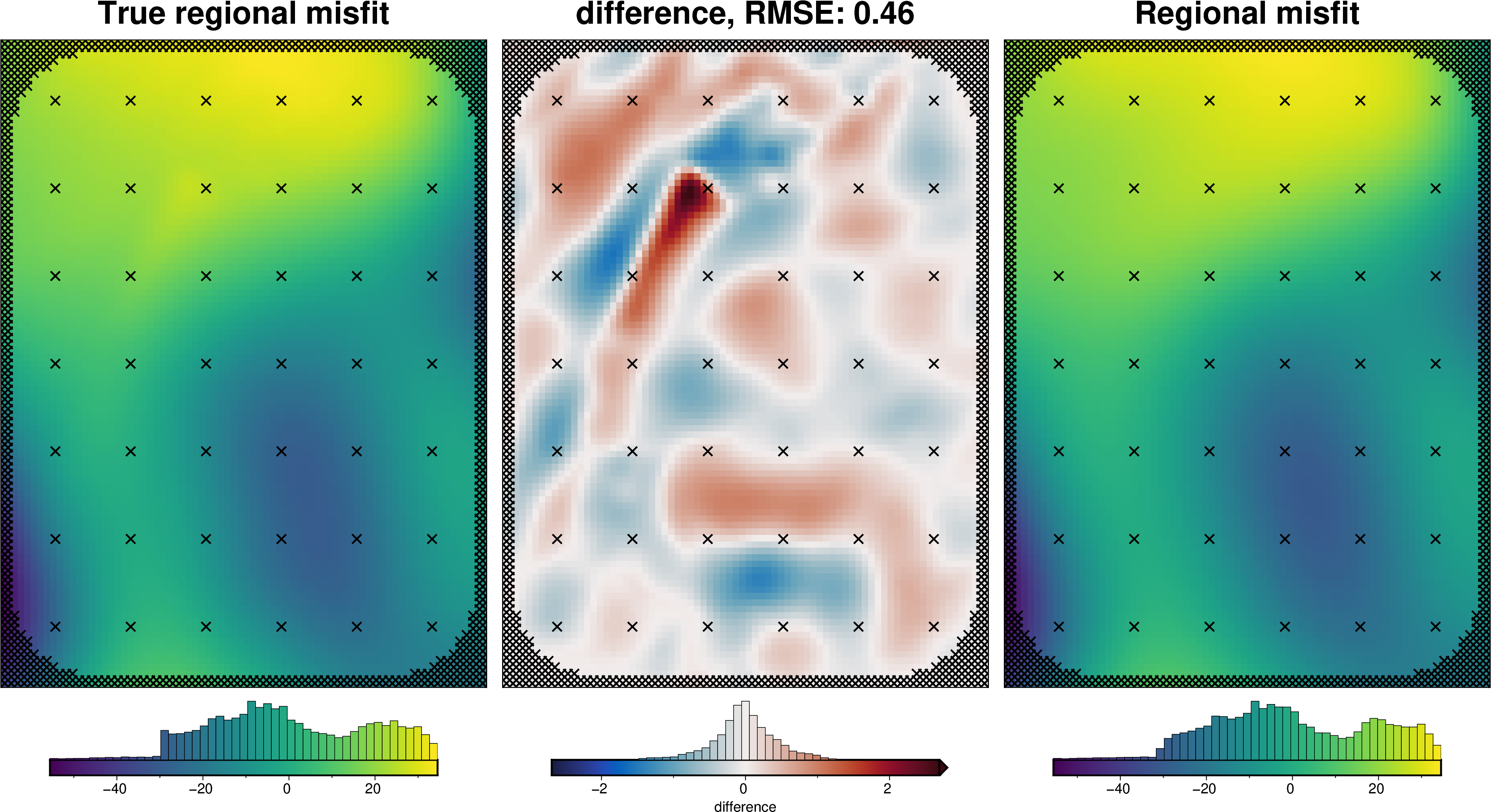
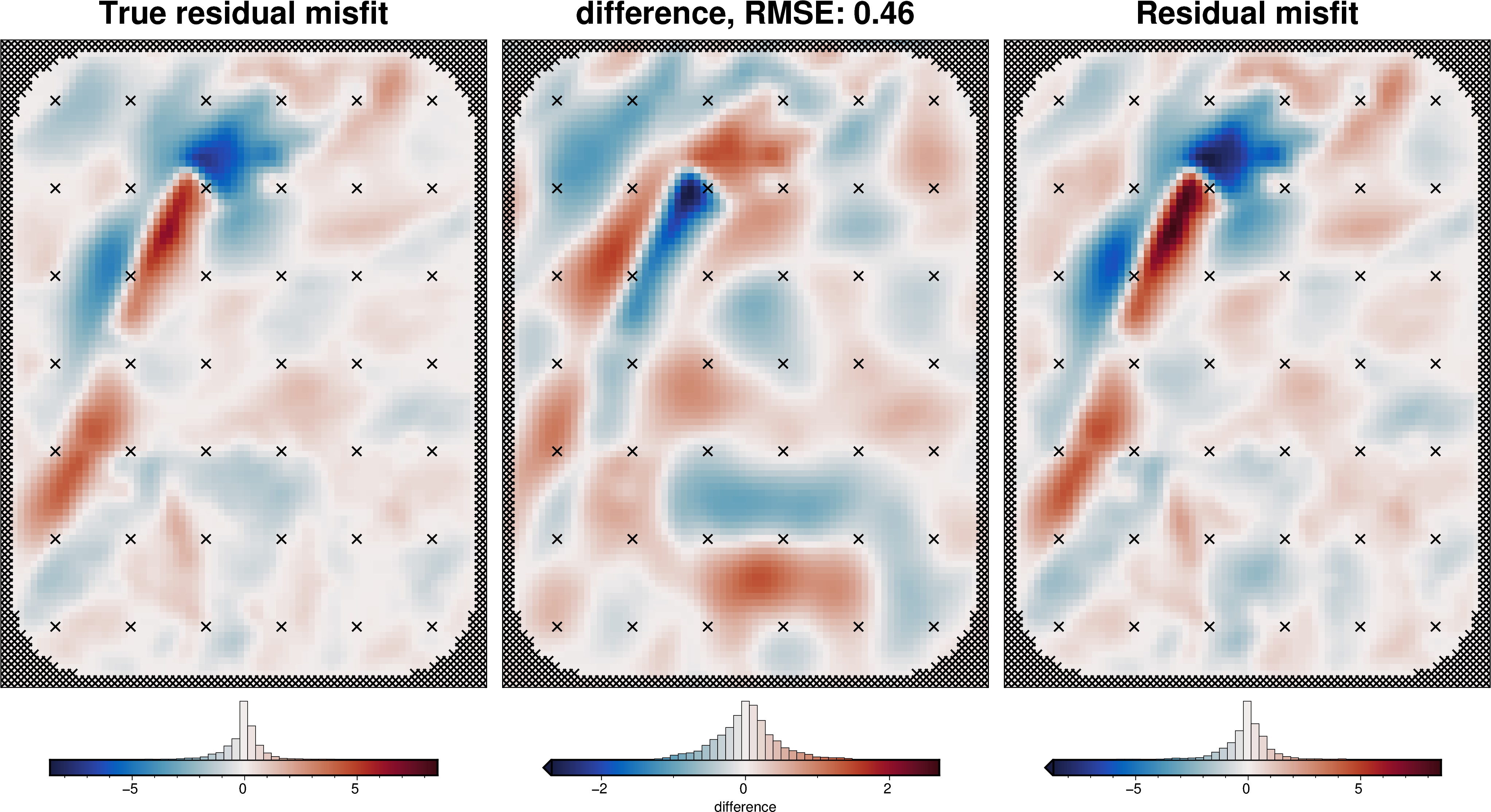
from polartoolkit import utils as polar_utils
import synthetic_bathymetry_inversion.plotting as synth_plotting
from synthetic_bathymetry_inversion import synthetic
os.environ["POLARTOOLKIT_HEMISPHERE"] = "south"
logging.getLogger().setLevel(logging.INFO)
/home/sungw937/miniforge3/envs/synthetic_bathymetry_inversion/lib/python3.12/site-packages/UQpy/__init__.py:6: UserWarning:
pkg_resources is deprecated as an API. See https://setuptools.pypa.io/en/latest/pkg_resources.html. The pkg_resources package is slated for removal as early as 2025-11-30. Refrain from using this package or pin to Setuptools<81.
[2]:
fpath = "../results/Ross_Sea/Ross_Sea_04"
Get synthetic model data
[3]:
# set grid parameters
spacing = 2e3
inversion_region = (-40e3, 110e3, -1600e3, -1400e3)
true_density_contrast = 1476
bathymetry, basement, grav_df = synthetic.load_synthetic_model(
spacing=spacing,
inversion_region=inversion_region,
buffer=spacing * 10,
basement=True,
zref=0,
bathymetry_density_contrast=true_density_contrast,
)
buffer_region = polar_utils.get_grid_info(bathymetry)[1]
requested spacing (2000.0) is smaller than the original (5000.0).
requested spacing (2000.0) is smaller than the original (5000.0).
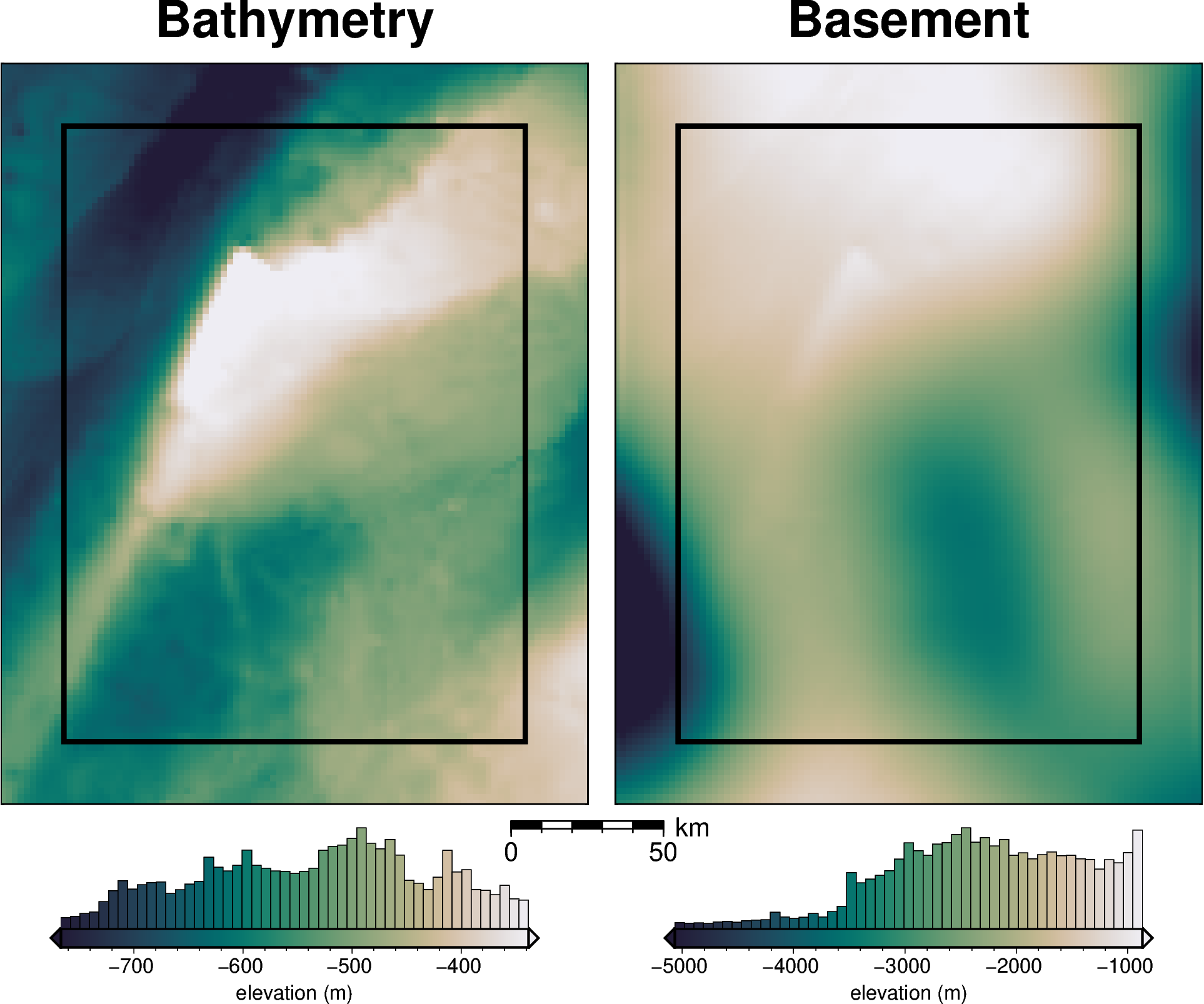
[4]:
# normalize regional gravity between -1 and 1
grav_df["basement_grav_normalized"] = (
vd.grid_to_table(
utils.normalize_xarray(
grav_df.set_index(["northing", "easting"]).to_xarray().basement_grav,
low=-1,
high=1,
)
)
.reset_index()
.basement_grav
)
grav_df = grav_df.drop(columns=["basement_grav", "disturbance", "gravity_anomaly"])
[5]:
# re-scale the regional gravity
regional_grav = utils.normalize_xarray(
grav_df.set_index(["northing", "easting"]).to_xarray().basement_grav_normalized,
low=0,
high=90,
).rename("basement_grav")
regional_grav -= regional_grav.mean()
# add to dataframe
grav_df["basement_grav"] = vd.grid_to_table(regional_grav).reset_index().basement_grav
# add basement and bathymetry forward gravities together to make observed gravity
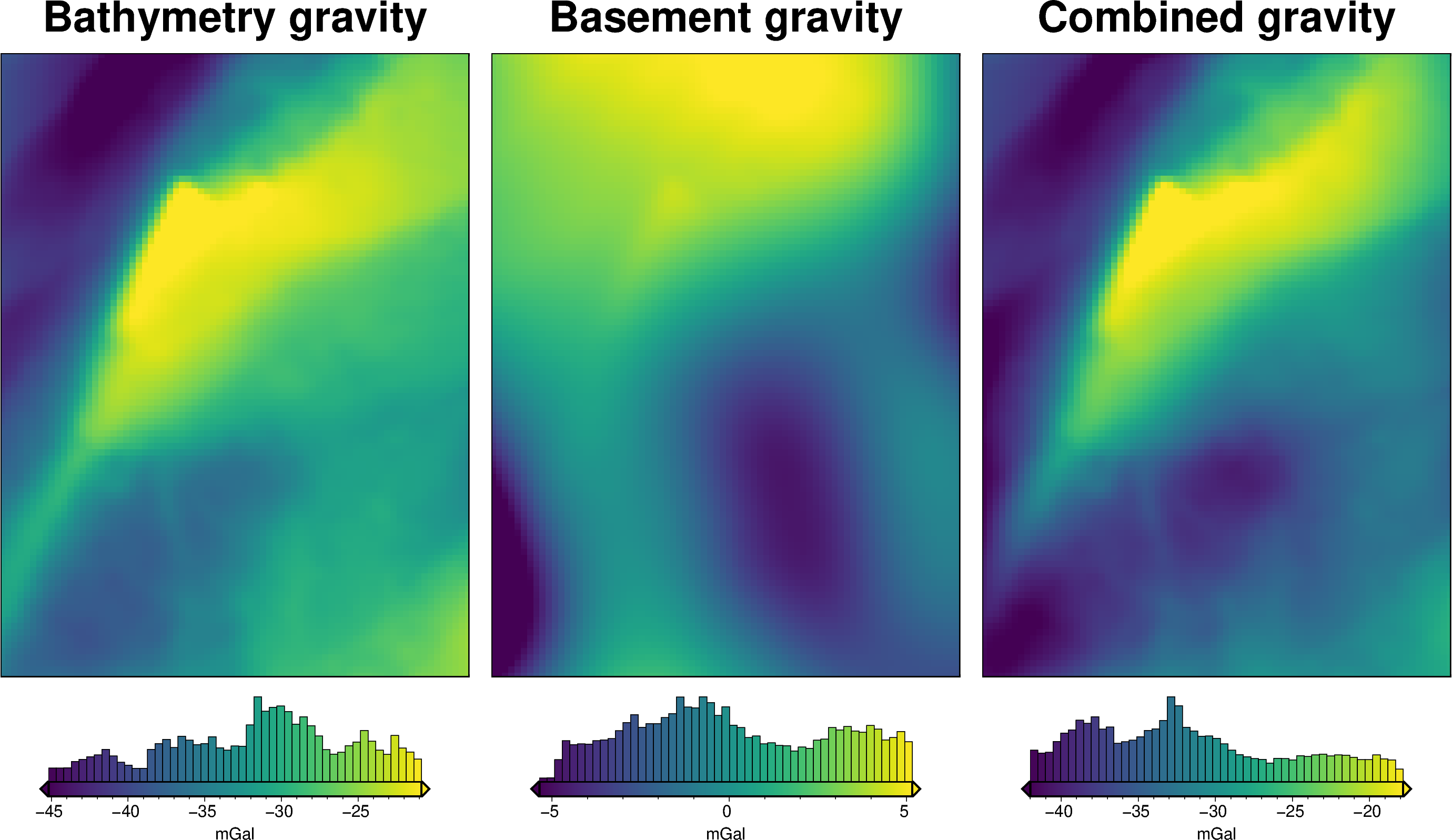
grav_df["gravity_anomaly"] = grav_df.bathymetry_grav + grav_df.basement_grav
new_reg = grav_df.set_index(["northing", "easting"]).to_xarray().basement_grav
new_reg -= new_reg.mean()
print(utils.rmse(new_reg))
18.399763167862545
[6]:
grav_df.basement_grav.std()
[6]:
np.float64(18.400961810459684)
[7]:
grav_df.bathymetry_grav.std()
[7]:
np.float64(6.458148145703343)
[8]:
grav_df.gravity_anomaly.std()
[8]:
np.float64(18.70563477739872)
[9]:
grav_df.gravity_anomaly.std() / grav_df.basement_grav.std()
[9]:
np.float64(1.016557447924589)
[10]:
grav_df
[10]:
| northing | easting | upward | bathymetry_grav | basement_grav_normalized | basement_grav | gravity_anomaly | |
|---|---|---|---|---|---|---|---|
| 0 | -1600000.0 | -40000.0 | 1000.0 | -35.551054 | -0.575610 | -36.298772 | -71.849826 |
| 1 | -1600000.0 | -38000.0 | 1000.0 | -36.054657 | -0.523194 | -33.940048 | -69.994704 |
| 2 | -1600000.0 | -36000.0 | 1000.0 | -36.473146 | -0.466341 | -31.381660 | -67.854806 |
| 3 | -1600000.0 | -34000.0 | 1000.0 | -36.755608 | -0.406001 | -28.666395 | -65.422003 |
| 4 | -1600000.0 | -32000.0 | 1000.0 | -36.951029 | -0.343146 | -25.837899 | -62.788928 |
| ... | ... | ... | ... | ... | ... | ... | ... |
| 7671 | -1400000.0 | 102000.0 | 1000.0 | -25.760090 | 0.399165 | 7.566093 | -18.193997 |
| 7672 | -1400000.0 | 104000.0 | 1000.0 | -25.911429 | 0.334795 | 4.669468 | -21.241961 |
| 7673 | -1400000.0 | 106000.0 | 1000.0 | -26.032814 | 0.268739 | 1.696911 | -24.335902 |
| 7674 | -1400000.0 | 108000.0 | 1000.0 | -26.121903 | 0.201713 | -1.319231 | -27.441134 |
| 7675 | -1400000.0 | 110000.0 | 1000.0 | -26.206160 | 0.134416 | -4.347629 | -30.553790 |
7676 rows × 7 columns
[11]:
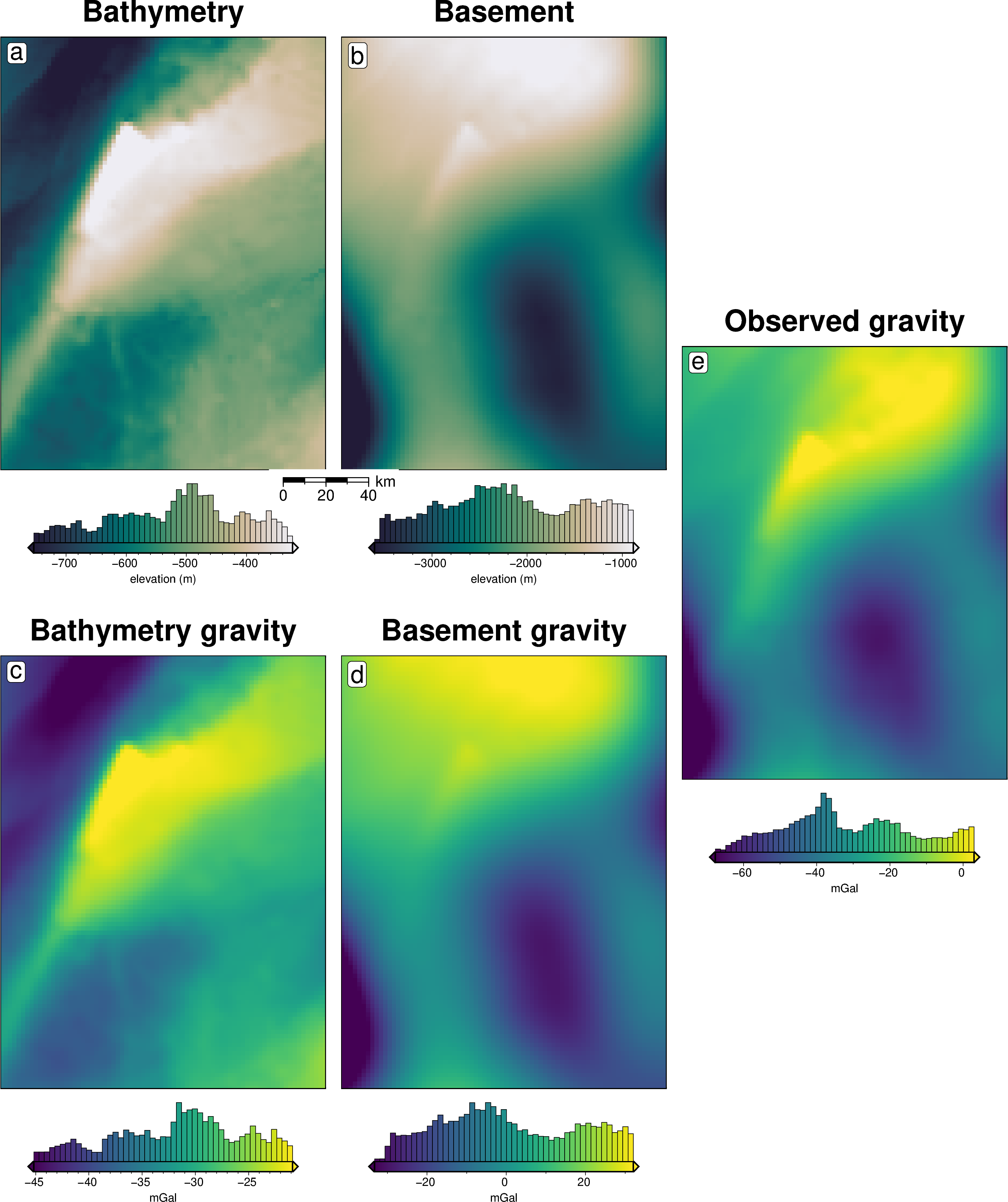
grav_grid = grav_df.set_index(["northing", "easting"]).to_xarray()
fig = maps.plot_grd(
bathymetry,
region=inversion_region,
fig_height=10,
title="Bathymetry",
hist=True,
cmap="rain",
reverse_cpt=True,
cbar_label="elevation (m)",
robust=True,
)
fig.text(
position="TL",
text="a",
fill="white",
pen=True,
font="16p,Helvetica,black",
offset="j.2/.2",
clearance="+tO",
no_clip=True,
)
fig = maps.plot_grd(
basement,
region=inversion_region,
fig_height=10,
title="Basement",
hist=True,
cmap="rain",
reverse_cpt=True,
cbar_label="elevation (m)",
fig=fig,
origin_shift="xshift",
robust=True,
scalebar=True,
scalebar_position="n-.05/-.03",
)
fig.text(
position="TL",
text="b",
fill="white",
pen=True,
font="16p,Helvetica,black",
offset="j.2/.2",
clearance="+tO",
no_clip=True,
)
# shift down and 3 to the left
fig = maps.plot_grd(
grav_grid.bathymetry_grav,
region=inversion_region,
fig_height=10,
title="Bathymetry gravity",
hist=True,
cbar_label="mGal",
fig=fig,
origin_shift="both",
xshift_amount=-1,
yshift_amount=-1,
robust=True,
)
fig.text(
position="TL",
text="c",
fill="white",
pen=True,
font="16p,Helvetica,black",
offset="j.2/.2",
clearance="+tO",
no_clip=True,
)
fig = maps.plot_grd(
grav_grid.basement_grav,
region=inversion_region,
fig_height=10,
title="Basement gravity",
hist=True,
cbar_label="mGal",
fig=fig,
origin_shift="xshift",
robust=True,
)
fig.text(
position="TL",
text="d",
fill="white",
pen=True,
font="16p,Helvetica,black",
offset="j.2/.2",
clearance="+tO",
no_clip=True,
)
fig = maps.plot_grd(
grav_grid.gravity_anomaly,
region=inversion_region,
fig_height=10,
title="Observed gravity",
hist=True,
cbar_label="mGal",
fig=fig,
origin_shift="both",
yshift_amount=0.5,
robust=True,
)
fig.text(
position="TL",
text="e",
fill="white",
pen=True,
font="16p,Helvetica,black",
offset="j.2/.2",
clearance="+tO",
no_clip=True,
)
fig.show()
Make starting bathymetry model
[12]:
# semi-regularly spaced
constraint_points = synthetic.constraint_layout_number(
shape=(6, 7),
region=inversion_region,
padding=-spacing,
shapefile="../results/Ross_Sea/Ross_Sea_outline.shp",
add_outside_points=True,
grid_spacing=spacing,
)
# sample true topography at these points
constraint_points = utils.sample_grids(
constraint_points,
bathymetry,
"true_upward",
coord_names=("easting", "northing"),
)
constraint_points["upward"] = constraint_points.true_upward
constraint_points.head()
[12]:
| northing | easting | inside | true_upward | upward | |
|---|---|---|---|---|---|
| 0 | -1600000.0 | -40000.0 | False | -601.093994 | -601.093994 |
| 1 | -1600000.0 | -38000.0 | False | -609.216919 | -609.216919 |
| 2 | -1600000.0 | -36000.0 | False | -616.355957 | -616.355957 |
| 3 | -1600000.0 | -34000.0 | False | -621.262268 | -621.262268 |
| 4 | -1600000.0 | -32000.0 | False | -625.510925 | -625.510925 |
[13]:
# grid the sampled values using verde
starting_topography_kwargs = dict(
method="splines",
region=buffer_region,
spacing=spacing,
constraints_df=constraint_points,
dampings=None,
)
starting_bathymetry = utils.create_topography(**starting_topography_kwargs)
starting_bathymetry
[13]:
<xarray.DataArray 'scalars' (northing: 121, easting: 96)> Size: 93kB
array([[-541.24413869, -544.57181187, -547.92293689, ..., -360.00006254,
-357.06767408, -354.19957766],
[-543.34402688, -546.81675803, -550.35256333, ..., -362.90253226,
-359.96874158, -357.11431886],
[-545.05533622, -548.66036838, -552.37518163, ..., -365.66137905,
-362.73269531, -359.90052824],
...,
[-591.95335283, -595.518822 , -599.06869705, ..., -440.89315875,
-440.6944619 , -440.40553782],
[-590.53134833, -594.09076637, -597.64079288, ..., -440.69158328,
-440.42525249, -440.07197234],
[-589.16632671, -592.73504777, -596.30209679, ..., -440.51760947,
-440.1713932 , -439.74434037]], shape=(121, 96))
Coordinates:
* northing (northing) float64 968B -1.62e+06 -1.618e+06 ... -1.38e+06
* easting (easting) float64 768B -6e+04 -5.8e+04 ... 1.28e+05 1.3e+05
Attributes:
metadata: Generated by SplineCV(cv=KFold(n_splits=5, random_state=0, shu...
damping: None[14]:
# sample the inverted topography at the constraint points
constraint_points = utils.sample_grids(
constraint_points,
starting_bathymetry,
"starting_bathymetry",
coord_names=("easting", "northing"),
)
constraint_points["dif"] = (
constraint_points.true_upward - constraint_points.starting_bathymetry
)
rmse = utils.rmse(constraint_points.dif)
print(f"RMSE: {rmse:.2f} m")
constraint_points
RMSE: 0.03 m
[14]:
| northing | easting | inside | true_upward | upward | starting_bathymetry | dif | |
|---|---|---|---|---|---|---|---|
| 0 | -1.600000e+06 | -4.000000e+04 | False | -601.093994 | -601.093994 | -601.093994 | 0.000000 |
| 1 | -1.600000e+06 | -3.800000e+04 | False | -609.216919 | -609.216919 | -609.216919 | 0.000000 |
| 2 | -1.600000e+06 | -3.600000e+04 | False | -616.355957 | -616.355957 | -616.355957 | 0.000000 |
| 3 | -1.600000e+06 | -3.400000e+04 | False | -621.262268 | -621.262268 | -621.262268 | 0.000000 |
| 4 | -1.600000e+06 | -3.200000e+04 | False | -625.510925 | -625.510925 | -625.510925 | 0.000000 |
| ... | ... | ... | ... | ... | ... | ... | ... |
| 881 | -1.418571e+06 | -3.637979e-12 | True | -747.305711 | -747.305711 | -747.289192 | -0.016520 |
| 882 | -1.418571e+06 | 2.333333e+04 | True | -619.672055 | -619.672055 | -619.459742 | -0.212313 |
| 883 | -1.418571e+06 | 4.666667e+04 | True | -505.761536 | -505.761536 | -505.739808 | -0.021728 |
| 884 | -1.418571e+06 | 7.000000e+04 | True | -447.753091 | -447.753091 | -447.782831 | 0.029740 |
| 885 | -1.418571e+06 | 9.333333e+04 | True | -395.004206 | -395.004206 | -395.079663 | 0.075456 |
886 rows × 7 columns
[15]:
# compare starting and actual bathymetry grids
grids = polar_utils.grd_compare(
bathymetry,
starting_bathymetry,
fig_height=10,
plot=True,
cmap="rain",
reverse_cpt=True,
diff_cmap="balance+h0",
grid1_name="True bathymetry",
grid2_name="Starting bathymetry",
title="Difference",
title_font="18p,Helvetica-Bold,black",
cbar_unit="m",
cbar_label="elevation",
RMSE_decimals=0,
region=inversion_region,
inset=False,
hist=True,
label_font="16p,Helvetica,black",
points=constraint_points[constraint_points.inside],
points_style="x.2c",
)
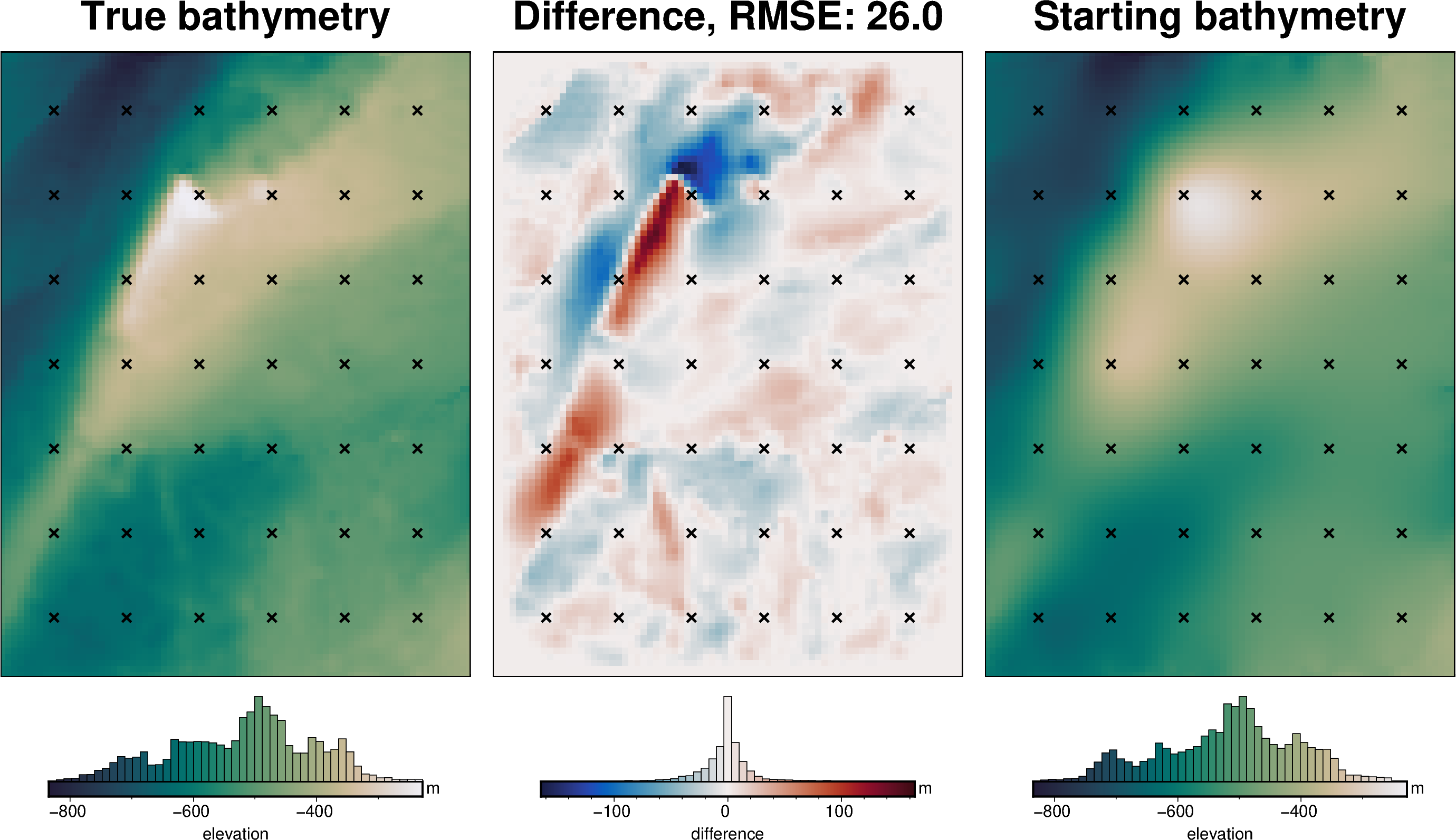
[16]:
# the true density contrast is 1476 kg/m3
density_contrast = 1350
# set the reference level from the prisms to 0
zref = 0
density_grid = xr.where(
starting_bathymetry >= zref,
density_contrast,
-density_contrast,
)
# create layer of prisms
starting_prisms = utils.grids_to_prisms(
starting_bathymetry,
zref,
density=density_grid,
)
grav_df["starting_gravity"] = starting_prisms.prism_layer.gravity(
coordinates=(
grav_df.easting,
grav_df.northing,
grav_df.upward,
),
field="g_z",
progressbar=True,
)
grav_df
[16]:
| northing | easting | upward | bathymetry_grav | basement_grav_normalized | basement_grav | gravity_anomaly | starting_gravity | |
|---|---|---|---|---|---|---|---|---|
| 0 | -1600000.0 | -40000.0 | 1000.0 | -35.551054 | -0.575610 | -36.298772 | -71.849826 | -32.541367 |
| 1 | -1600000.0 | -38000.0 | 1000.0 | -36.054657 | -0.523194 | -33.940048 | -69.994704 | -32.965831 |
| 2 | -1600000.0 | -36000.0 | 1000.0 | -36.473146 | -0.466341 | -31.381660 | -67.854806 | -33.347648 |
| 3 | -1600000.0 | -34000.0 | 1000.0 | -36.755608 | -0.406001 | -28.666395 | -65.422003 | -33.644496 |
| 4 | -1600000.0 | -32000.0 | 1000.0 | -36.951029 | -0.343146 | -25.837899 | -62.788928 | -33.840063 |
| ... | ... | ... | ... | ... | ... | ... | ... | ... |
| 7671 | -1400000.0 | 102000.0 | 1000.0 | -25.760090 | 0.399165 | 7.566093 | -18.193997 | -23.321506 |
| 7672 | -1400000.0 | 104000.0 | 1000.0 | -25.911429 | 0.334795 | 4.669468 | -21.241961 | -23.482116 |
| 7673 | -1400000.0 | 106000.0 | 1000.0 | -26.032814 | 0.268739 | 1.696911 | -24.335902 | -23.605602 |
| 7674 | -1400000.0 | 108000.0 | 1000.0 | -26.121903 | 0.201713 | -1.319231 | -27.441134 | -23.693171 |
| 7675 | -1400000.0 | 110000.0 | 1000.0 | -26.206160 | 0.134416 | -4.347629 | -30.553790 | -23.763780 |
7676 rows × 8 columns
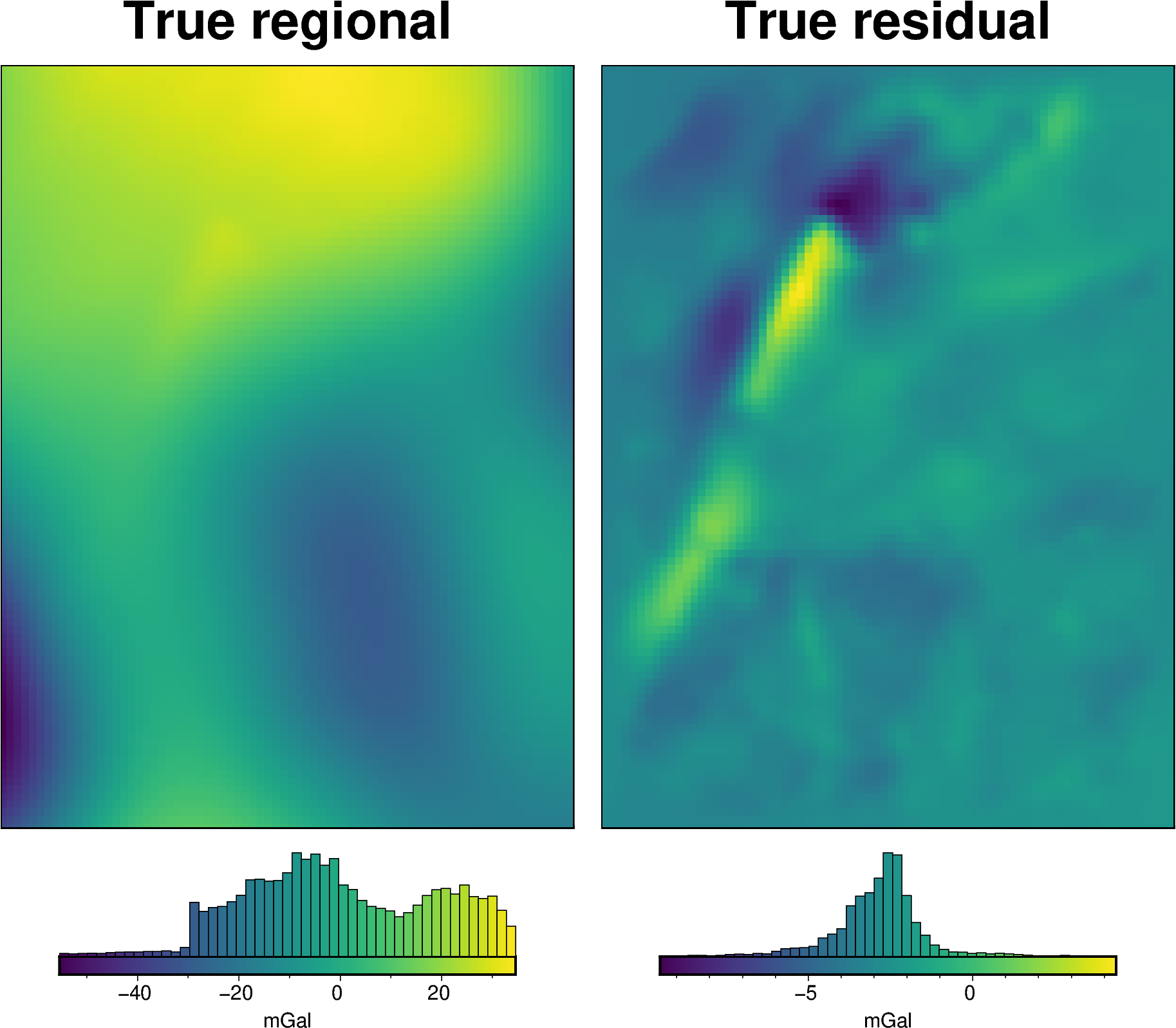
Regional misfit
[17]:
# calculate the true residual misfit
grav_df["true_res"] = grav_df.bathymetry_grav - grav_df.starting_gravity
# grid the results
grav_grid = grav_df.set_index(["northing", "easting"]).to_xarray()
fig = maps.plot_grd(
grav_grid.basement_grav,
fig_height=10,
title="True regional",
hist=True,
cbar_label="mGal",
)
fig = maps.plot_grd(
grav_grid.true_res,
fig=fig,
origin_shift="xshift",
fig_height=10,
title="True residual",
hist=True,
cbar_label="mGal",
)
fig.show()
[18]:
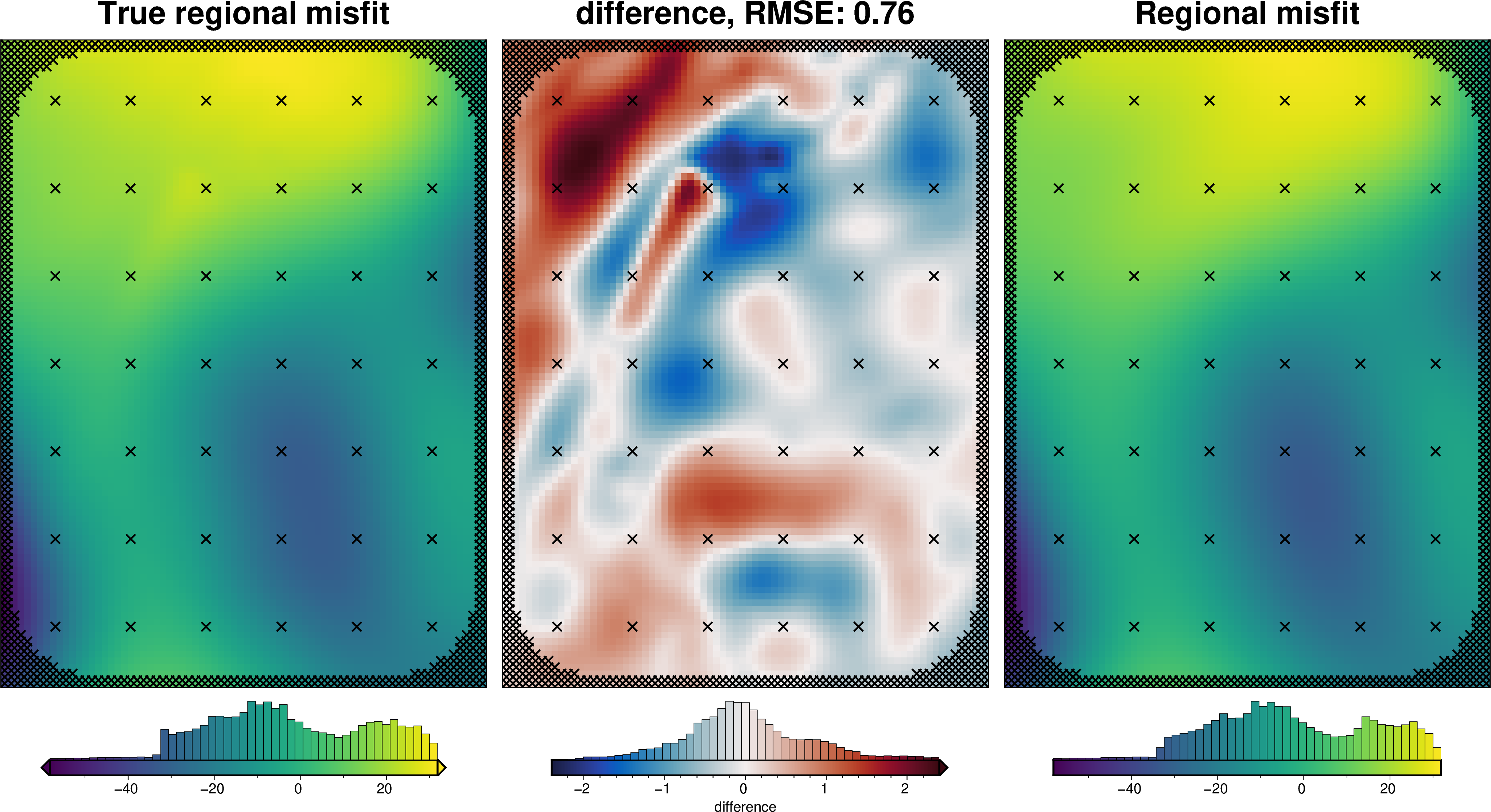
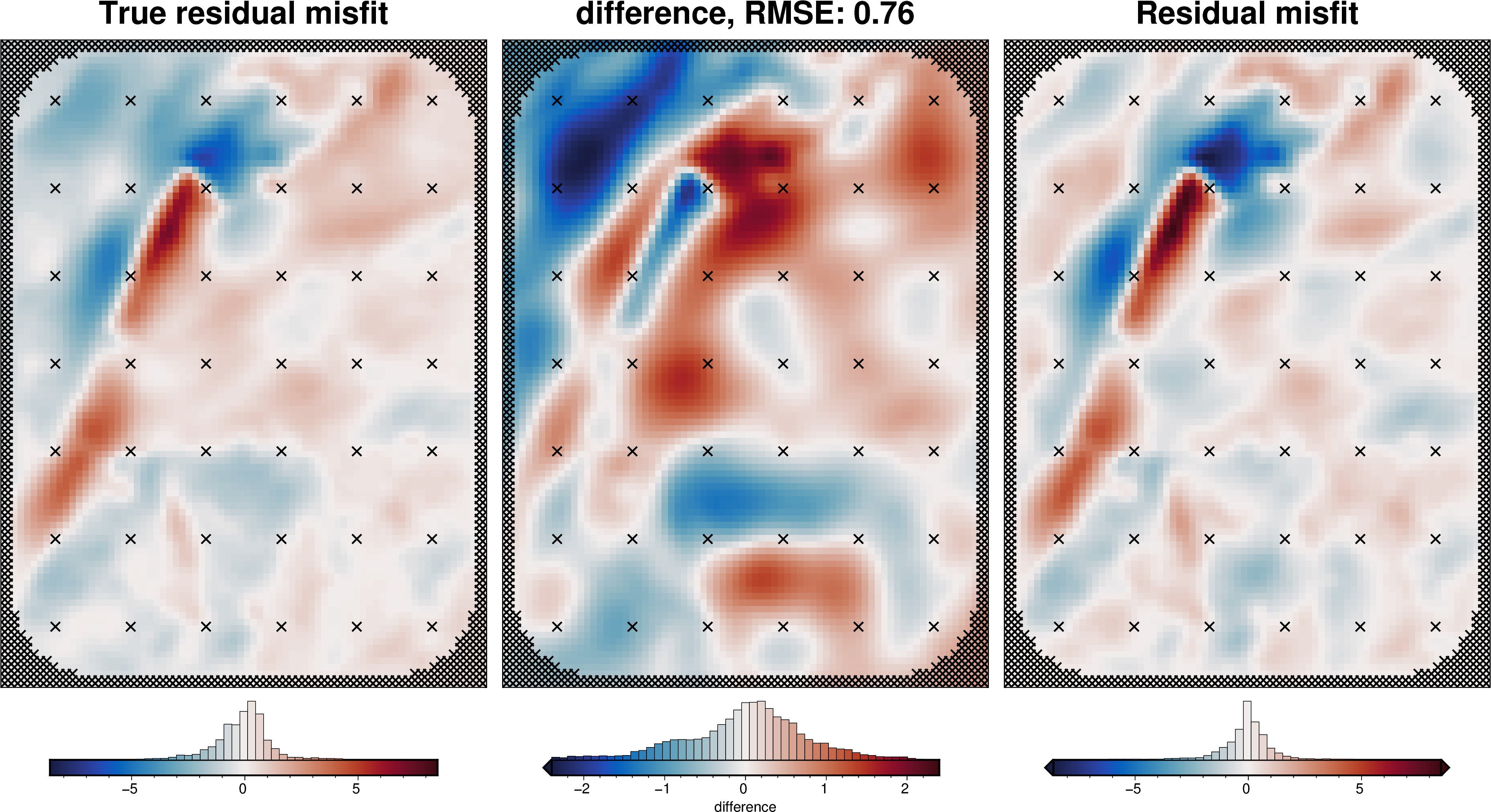
def regional_comparison(df):
# grid the results
grav_grid = df.set_index(["northing", "easting"]).to_xarray()
# calculate the true residual and regional misfit
grav_grid["true_res"] = grav_grid.bathymetry_grav - grav_grid.starting_gravity
grav_grid["true_reg"] = grav_grid.basement_grav
# compare with true regional
_ = polar_utils.grd_compare(
grav_grid.true_reg - (grav_grid.true_reg.mean() - grav_grid.reg.mean()),
grav_grid.reg,
plot=True,
grid1_name="True regional misfit",
grid2_name="Regional misfit",
hist=True,
inset=False,
verbose="q",
title="difference",
grounding_line=False,
points=constraint_points,
points_style="x.3c",
)
# compare with true residual
_ = polar_utils.grd_compare(
grav_grid.true_res - (grav_grid.true_res.mean() - grav_grid.res.mean()),
grav_grid.res,
plot=True,
grid1_name="True residual misfit",
grid2_name="Residual misfit",
cmap="balance+h0",
hist=True,
inset=False,
verbose="q",
title="difference",
grounding_line=False,
points=constraint_points,
points_style="x.3c",
)
[19]:
# estimate regional with the mean misfit at constraints
regional_grav_kwargs = dict(
method="constraints",
grid_method="eq_sources",
constraints_df=constraint_points,
cv=True,
cv_kwargs=dict(
n_trials=20,
depth_limits=(100, 400e3),
progressbar=False,
fname="../tmp_outputs/Ross_Sea_04_regional_sep",
),
block_size=None,
damping=None,
)
[20]:
temp_reg_kwargs = copy.deepcopy(regional_grav_kwargs)
# temporarily set some kwargs
temp_reg_kwargs["cv_kwargs"]["plot"] = True
temp_reg_kwargs["cv_kwargs"]["progressbar"] = True
grav_df = regional.regional_separation(
grav_df=grav_df,
**temp_reg_kwargs,
)
regional_comparison(grav_df)
grav_df.describe()
[20]:
| northing | easting | upward | bathymetry_grav | basement_grav_normalized | basement_grav | gravity_anomaly | starting_gravity | true_res | misfit | reg | res | |
|---|---|---|---|---|---|---|---|---|---|---|---|---|
| count | 7.676000e+03 | 7676.000000 | 7676.0 | 7676.000000 | 7676.000000 | 7.676000e+03 | 7676.000000 | 7676.000000 | 7676.000000 | 7676.000000 | 7676.000000 | 7676.000000 |
| mean | -1.500000e+06 | 35000.000000 | 1000.0 | -31.727281 | 0.231030 | -7.583072e-15 | -31.727281 | -28.869499 | -2.857783 | -2.857783 | -2.757333 | -0.100450 |
| std | 5.831332e+04 | 43877.680138 | 0.0 | 6.458148 | 0.408910 | 1.840096e+01 | 18.705635 | 5.735684 | 1.373353 | 18.203440 | 18.308589 | 1.507758 |
| min | -1.600000e+06 | -40000.000000 | 1000.0 | -48.457772 | -1.000000 | -5.539633e+01 | -86.255473 | -44.455618 | -9.507972 | -58.143654 | -58.148433 | -8.610022 |
| 25% | -1.550000e+06 | -2500.000000 | 1000.0 | -36.286366 | -0.073820 | -1.371824e+01 | -44.456508 | -32.676771 | -3.516046 | -16.404558 | -16.478774 | -0.528250 |
| 50% | -1.500000e+06 | 35000.000000 | 1000.0 | -31.030069 | 0.181836 | -2.213697e+00 | -34.787733 | -28.426806 | -2.725032 | -5.023125 | -4.863039 | -0.005071 |
| 75% | -1.450000e+06 | 72500.000000 | 1000.0 | -27.278975 | 0.596584 | 1.644995e+01 | -18.710925 | -24.769776 | -2.210131 | 13.396719 | 13.664678 | 0.447635 |
| max | -1.400000e+06 | 110000.000000 | 1000.0 | -16.585798 | 1.000000 | 3.460367e+01 | 9.233533 | -15.540467 | 4.358587 | 32.411323 | 31.110975 | 8.509408 |
[21]:
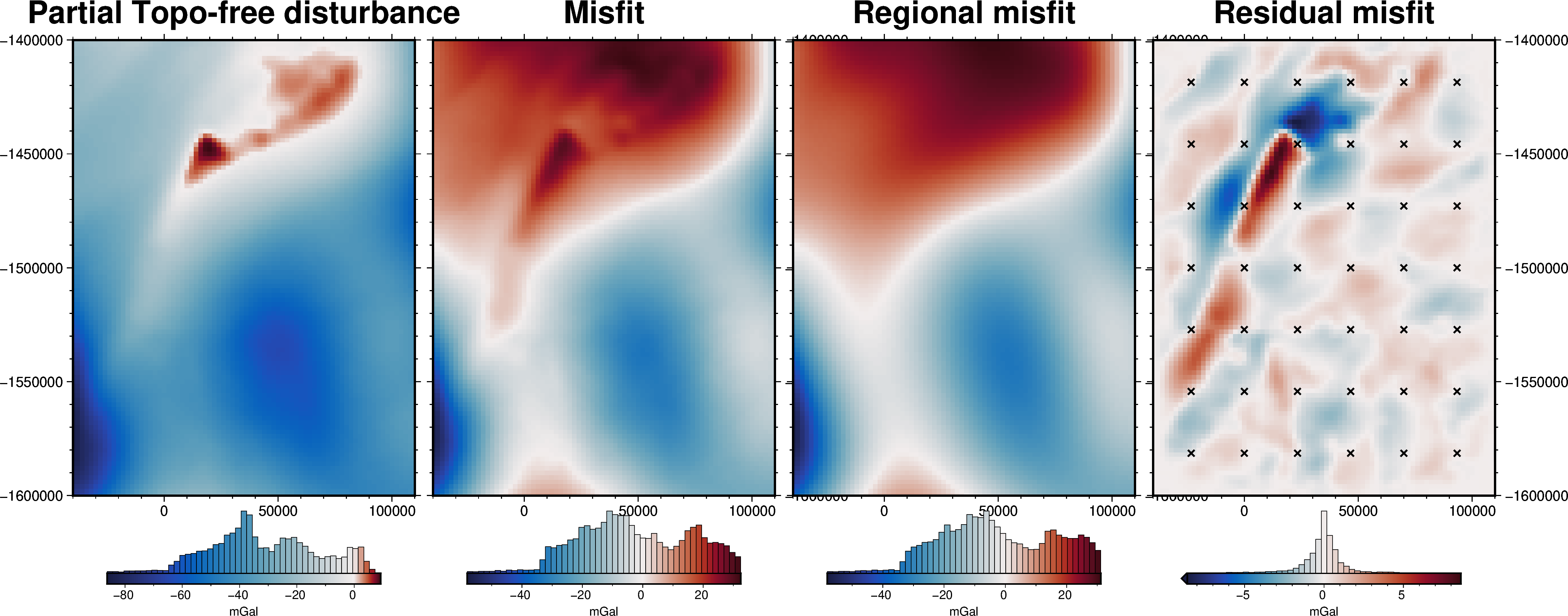
grav_grid = grav_df.set_index(["northing", "easting"]).to_xarray()
fig = maps.plot_grd(
grav_grid.gravity_anomaly,
region=inversion_region,
fig_height=10,
title="Partial Topo-free disturbance",
cmap="balance+h0",
hist=True,
cbar_label="mGal",
frame=["nSWe", "xaf10000", "yaf10000"],
)
fig = maps.plot_grd(
grav_grid.misfit,
region=inversion_region,
fig=fig,
origin_shift="xshift",
fig_height=10,
title="Misfit",
cmap="balance+h0",
hist=True,
cbar_label="mGal",
frame=["nSwE", "xaf10000", "yaf10000"],
)
fig = maps.plot_grd(
grav_grid.reg,
region=inversion_region,
fig=fig,
origin_shift="xshift",
fig_height=10,
title="Regional misfit",
cmap="balance+h0",
hist=True,
cbar_label="mGal",
frame=["nSwE", "xaf10000", "yaf10000"],
)
fig = maps.plot_grd(
grav_grid.res,
region=inversion_region,
fig=fig,
origin_shift="xshift",
fig_height=10,
title="Residual misfit",
cmap="balance+h0",
cpt_lims=[-vd.maxabs(grav_grid.res), vd.maxabs(grav_grid.res)],
hist=True,
cbar_label="mGal",
frame=["nSwE", "xaf10000", "yaf10000"],
points=constraint_points[constraint_points.inside],
points_style="x.2c",
)
fig.show()
[22]:
# set kwargs to pass to the inversion
kwargs = {
# set stopping criteria
"max_iterations": 200,
"l2_norm_tolerance": 0.2**0.5, # square root of the gravity noise
"delta_l2_norm_tolerance": 1.008,
}
Damping Cross Validation
[44]:
logging.getLogger().setLevel(logging.INFO)
# run the inversion workflow, including a cross validation for the damping parameter
results = inversion.run_inversion_workflow(
grav_df=grav_df,
starting_prisms=starting_prisms,
# for creating test/train splits
grav_spacing=spacing,
inversion_region=inversion_region,
run_damping_cv=True,
damping_limits=(0.001, 0.1),
damping_cv_trials=8,
fname=f"{fpath}_damping_cv",
**kwargs,
)
[23]:
# load saved inversion results
with pathlib.Path(f"{fpath}_damping_cv_results.pickle").open("rb") as f:
results = pickle.load(f)
# load study
with pathlib.Path(f"{fpath}_damping_cv_damping_cv_study.pickle").open("rb") as f:
study = pickle.load(f)
# collect the results
topo_results, grav_results, parameters, elapsed_time = results
[24]:
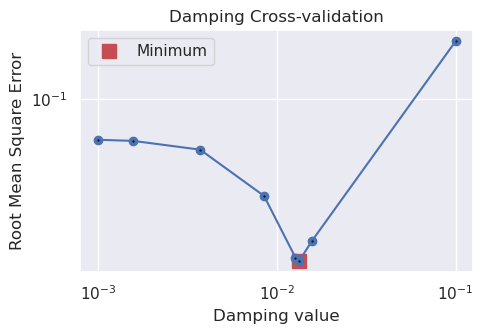
best_damping = parameters.get("Solver damping")
kwargs["solver_damping"] = best_damping
best_damping
[24]:
0.013382994085308205
[25]:
study_df = study.trials_dataframe()
plotting.plot_cv_scores(
study_df.value,
study_df.params_damping,
param_name="Damping",
logx=True,
logy=True,
)
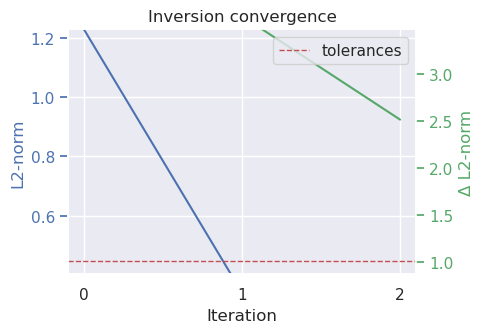
plotting.plot_convergence(
grav_results,
params=parameters,
)
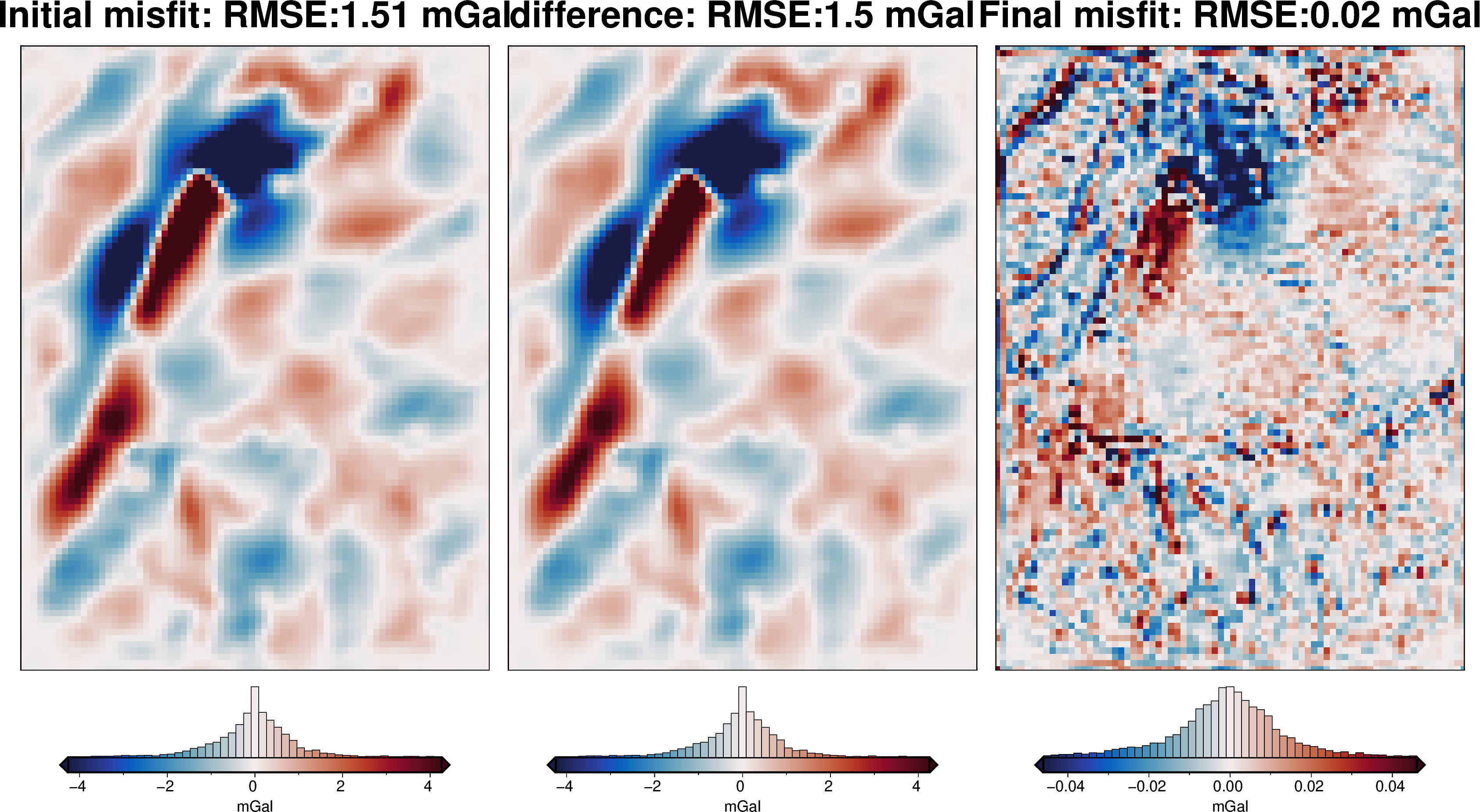
plotting.plot_inversion_results(
grav_results,
topo_results,
parameters,
inversion_region,
iters_to_plot=2,
plot_iter_results=True,
plot_topo_results=True,
plot_grav_results=True,
)
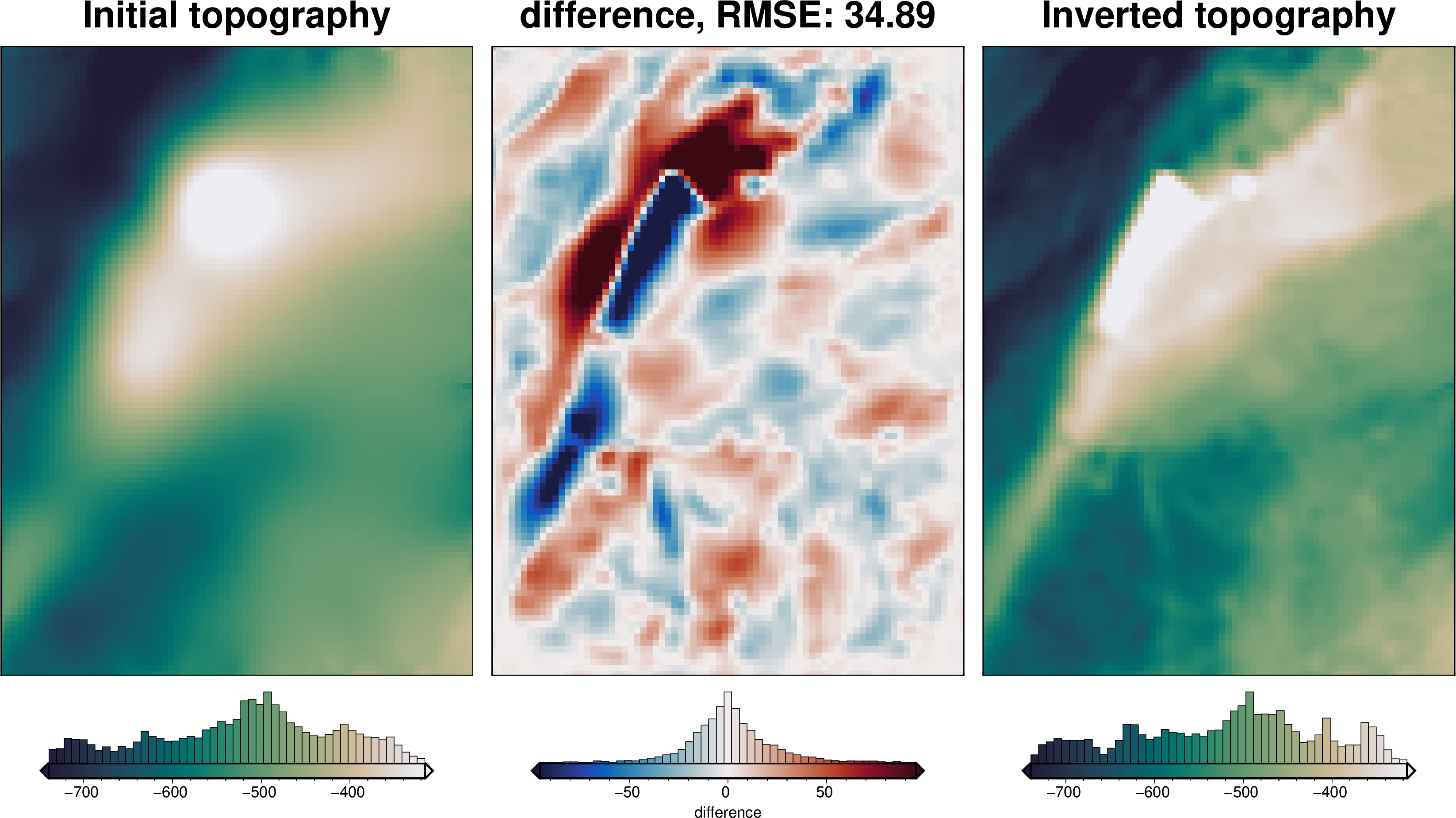
final_topography = topo_results.set_index(["northing", "easting"]).to_xarray().topo
_ = polar_utils.grd_compare(
bathymetry,
final_topography,
region=inversion_region,
plot=True,
grid1_name="True topography",
grid2_name="Inverted topography",
robust=True,
hist=True,
inset=False,
verbose="q",
title="difference",
grounding_line=False,
reverse_cpt=True,
cmap="rain",
points=constraint_points[constraint_points.inside],
points_style="x.2c",
)
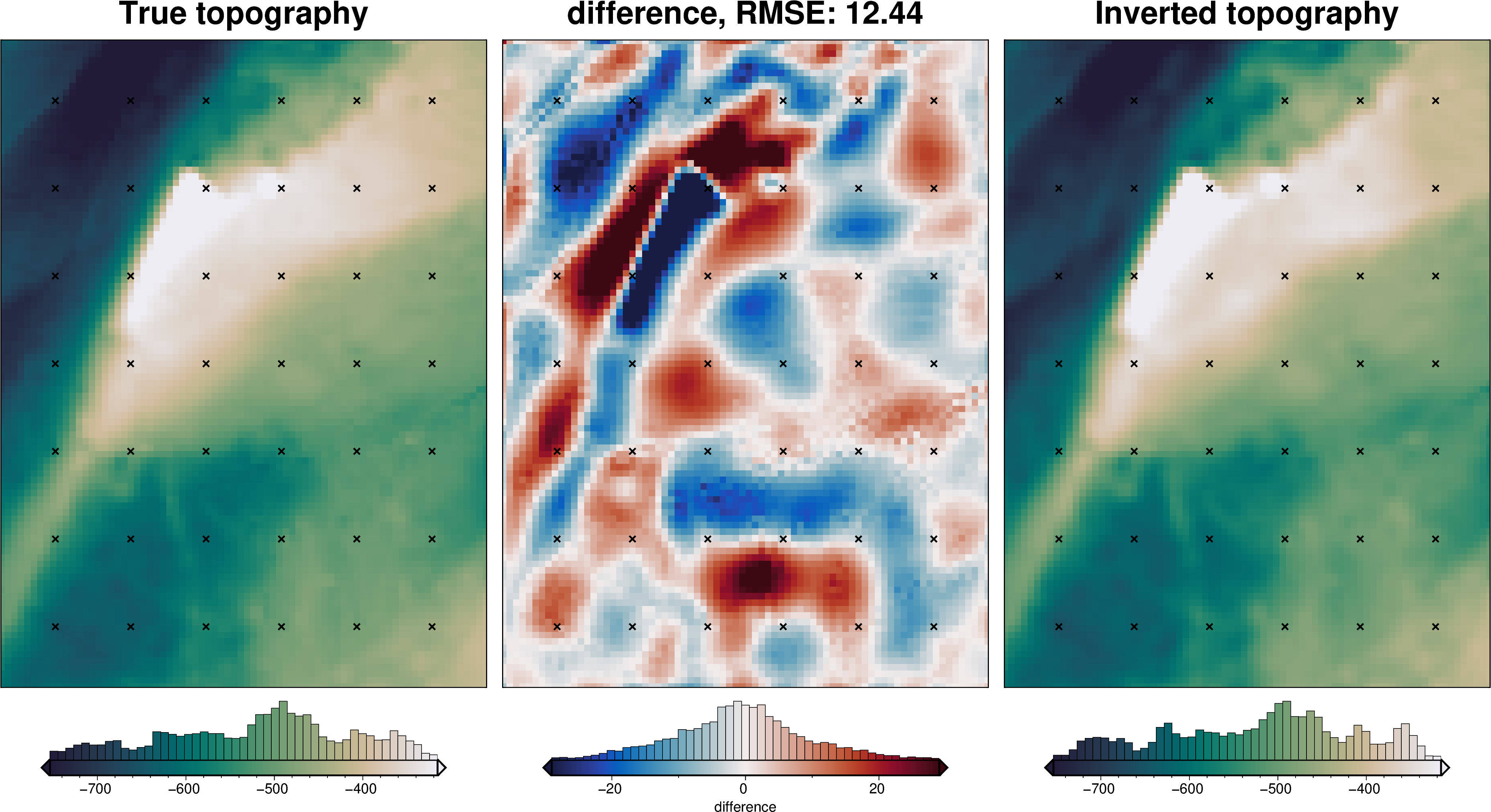
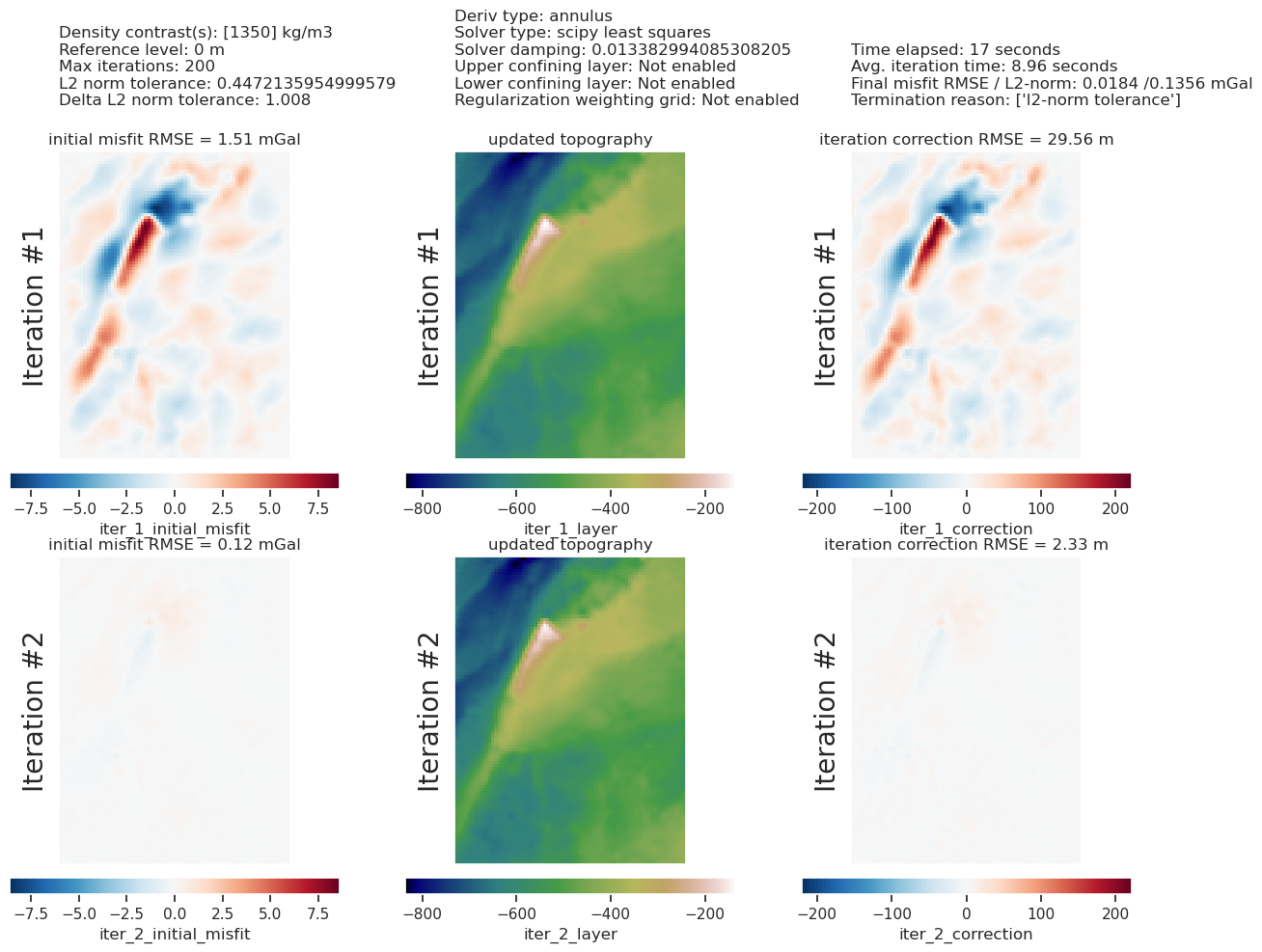
[26]:
# sample the inverted topography at the constraint points
constraint_points = utils.sample_grids(
constraint_points,
final_topography,
"inverted_topography",
coord_names=("easting", "northing"),
)
rmse = utils.rmse(constraint_points.upward - constraint_points.inverted_topography)
print(f"RMSE: {rmse:.2f} m")
RMSE: 5.35 m
Density CV
[49]:
# run the cross validation for density
study, inversion_results = optimization.optimize_inversion_zref_density_contrast(
grav_df=grav_df,
constraints_df=constraint_points,
density_contrast_limits=(1000, 2400),
zref=0,
n_trials=8,
starting_topography=starting_bathymetry,
regional_grav_kwargs=dict(
method="constant",
constant=0,
),
fname=f"{fpath}_density_cv",
**kwargs,
)
'starting_gravity' already a column of `grav_df`, but is being overwritten since calculate_starting_gravity is True
'reg' already a column of `grav_df`, but is being overwritten since calculate_regional_misfit is True
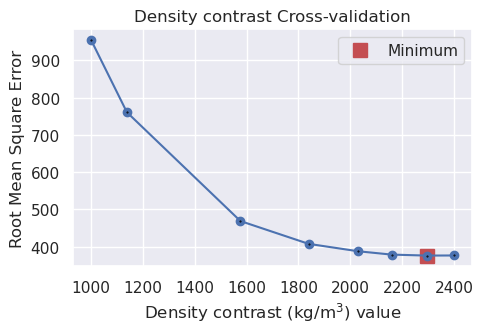
[50]:
# run a 5-fold cross validation for 10 parameter sets of density
# this performs 50 regional separations and 50 inversions
study, inversion_results = optimization.optimize_inversion_zref_density_contrast_kfolds(
grav_df=grav_df,
constraints_df=constraint_points[constraint_points.inside],
density_contrast_limits=(1000, 2400),
zref=0,
n_trials=12,
split_kwargs=dict(
n_splits=4,
method="KFold",
),
seed=2,
regional_grav_kwargs=regional_grav_kwargs,
starting_topography_kwargs=starting_topography_kwargs,
fname=f"{fpath}_density_cv_kfolds",
fold_progressbar=False,
**kwargs,
)
'starting_gravity' already a column of `grav_df`, but is being overwritten since calculate_starting_gravity is True
'reg' already a column of `grav_df`, but is being overwritten since calculate_regional_misfit is True
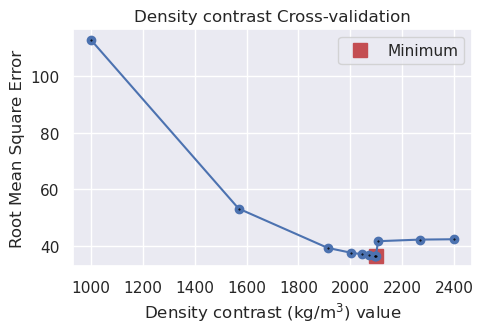
[27]:
# load study from normal optimization
with pathlib.Path(f"{fpath}_density_cv_study.pickle").open("rb") as f:
study = pickle.load(f)
optimized_density = study.best_params["density_contrast"]
# load study from kfold optimization
with pathlib.Path(f"{fpath}_density_cv_kfolds_study.pickle").open("rb") as f:
study = pickle.load(f)
kfold_optimized_density = study.best_params["density_contrast"]
print("optimal density contrast from normal optimization: ", optimized_density)
print("optimal density contrast from K-folds optimization: ", kfold_optimized_density)
print("real density contrast", true_density_contrast)
best_density_contrast = min(
[optimized_density, kfold_optimized_density],
key=lambda x: abs(x - true_density_contrast),
)
optimal density contrast from normal optimization: 2294
optimal density contrast from K-folds optimization: 2099
real density contrast 1476
[28]:
print("optimal determined density contrast", best_density_contrast)
print("real density contrast", true_density_contrast)
print("density error", best_density_contrast - true_density_contrast)
optimal determined density contrast 2099
real density contrast 1476
density error 623
Redo with optimal density contrast
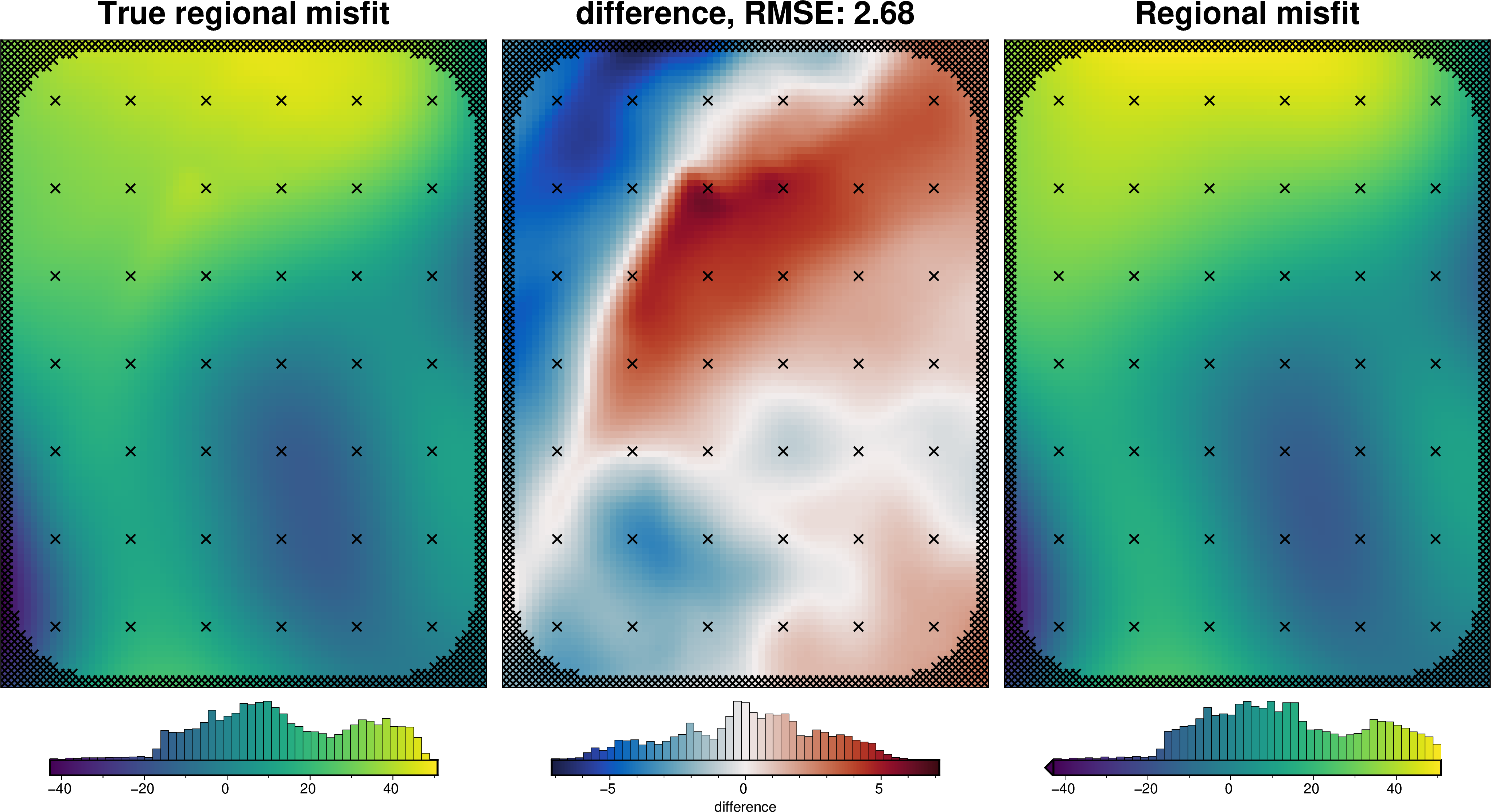
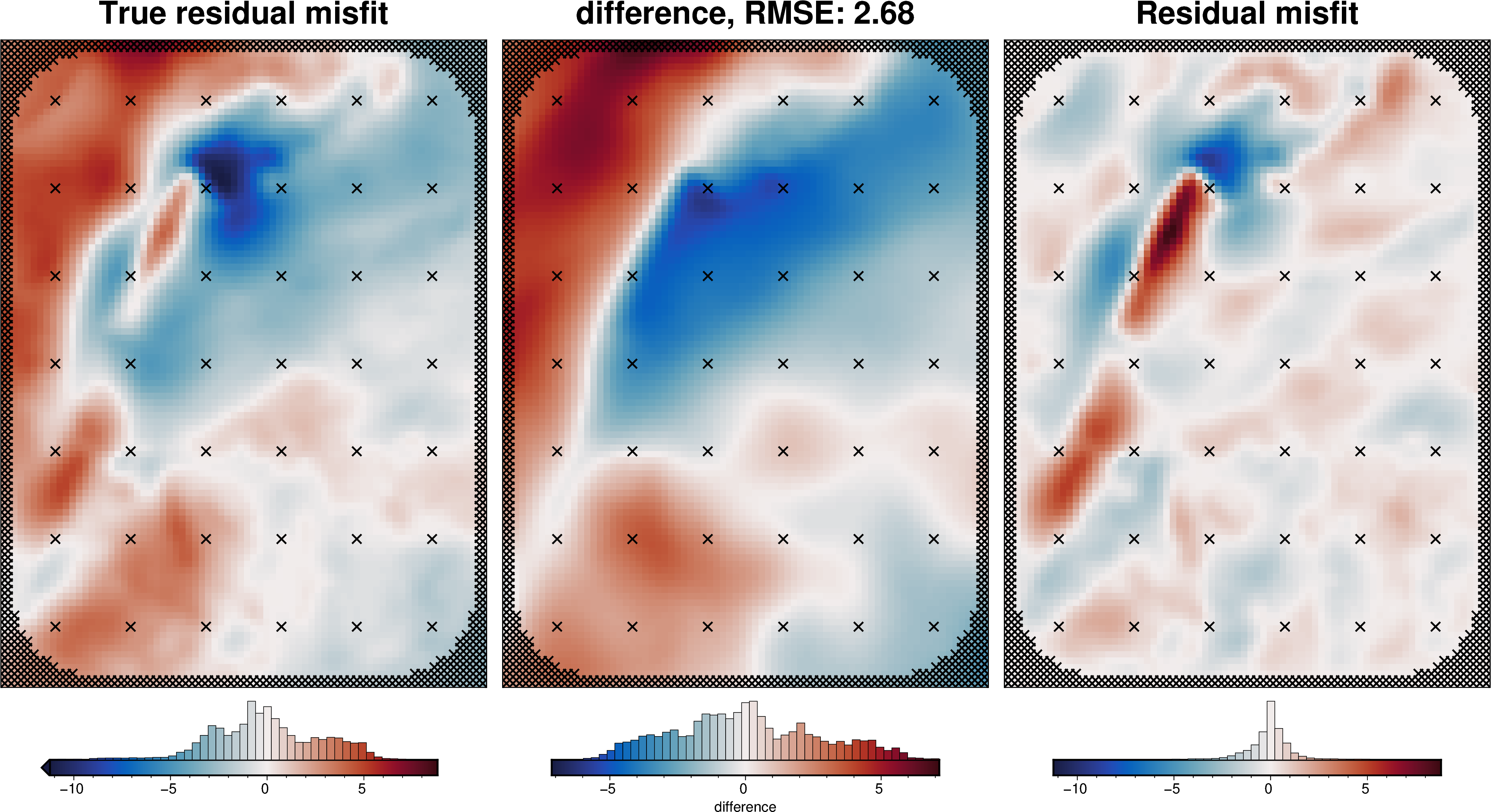
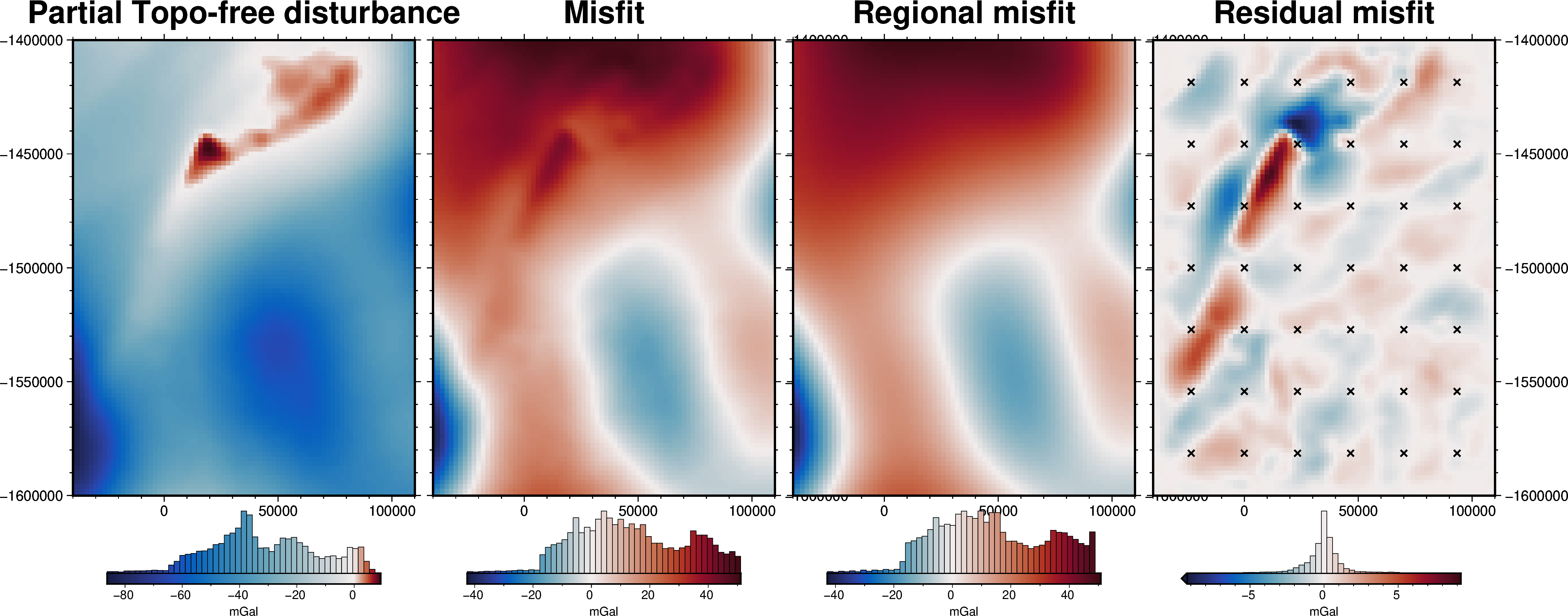
During the density cross-validation to avoid biasing the scores, we had to manually set a regional field. Now, with the optimal density contrast value found, we can rerun the inversion with an automatically determined regional field strength (the average value misfit at the constraints).
[29]:
density_contrast = best_density_contrast
density_grid = xr.where(
starting_bathymetry >= zref,
density_contrast,
-density_contrast,
)
# create layer of prisms
starting_prisms = utils.grids_to_prisms(
starting_bathymetry,
zref,
density=density_grid,
)
grav_df["starting_gravity"] = starting_prisms.prism_layer.gravity(
coordinates=(
grav_df.easting,
grav_df.northing,
grav_df.upward,
),
field="g_z",
progressbar=True,
)
grav_df = regional.regional_separation(
grav_df=grav_df,
**regional_grav_kwargs,
)
regional_comparison(grav_df)
[30]:
grav_grid = grav_df.set_index(["northing", "easting"]).to_xarray()
fig = maps.plot_grd(
grav_grid.gravity_anomaly,
region=inversion_region,
fig_height=10,
title="Partial Topo-free disturbance",
cmap="balance+h0",
hist=True,
cbar_label="mGal",
frame=["nSWe", "xaf10000", "yaf10000"],
)
fig = maps.plot_grd(
grav_grid.misfit,
region=inversion_region,
fig=fig,
origin_shift="xshift",
fig_height=10,
title="Misfit",
cmap="balance+h0",
hist=True,
cbar_label="mGal",
frame=["nSwE", "xaf10000", "yaf10000"],
)
fig = maps.plot_grd(
grav_grid.reg,
region=inversion_region,
fig=fig,
origin_shift="xshift",
fig_height=10,
title="Regional misfit",
cmap="balance+h0",
hist=True,
cbar_label="mGal",
frame=["nSwE", "xaf10000", "yaf10000"],
)
fig = maps.plot_grd(
grav_grid.res,
region=inversion_region,
fig=fig,
origin_shift="xshift",
fig_height=10,
title="Residual misfit",
cmap="balance+h0",
cpt_lims=[-vd.maxabs(grav_grid.res), vd.maxabs(grav_grid.res)],
hist=True,
cbar_label="mGal",
frame=["nSwE", "xaf10000", "yaf10000"],
points=constraint_points[constraint_points.inside],
points_style="x.2c",
)
fig.show()
[31]:
# run the inversion workflow
inversion_results = inversion.run_inversion_workflow(
grav_df=grav_df,
fname=f"{fpath}_optimal",
starting_prisms=starting_prisms,
plot_dynamic_convergence=True,
**kwargs,
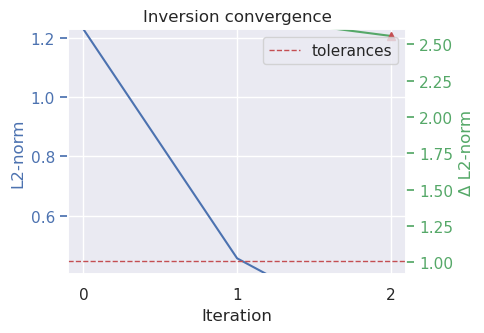
)
[32]:
# load saved inversion results
with pathlib.Path(f"{fpath}_optimal_results.pickle").open("rb") as f:
results = pickle.load(f)
# collect the results
topo_results, grav_results, parameters, elapsed_time = results
final_topography = topo_results.set_index(["northing", "easting"]).to_xarray().topo
[33]:
_ = polar_utils.grd_compare(
bathymetry,
final_topography,
fig_height=10,
region=inversion_region,
plot=True,
grid1_name="True topography",
grid2_name="Inverted topography",
robust=True,
hist=True,
inset=False,
verbose="q",
title="Error",
grounding_line=False,
reverse_cpt=True,
cmap="rain",
points=constraint_points[constraint_points.inside],
points_style="x.2c",
)
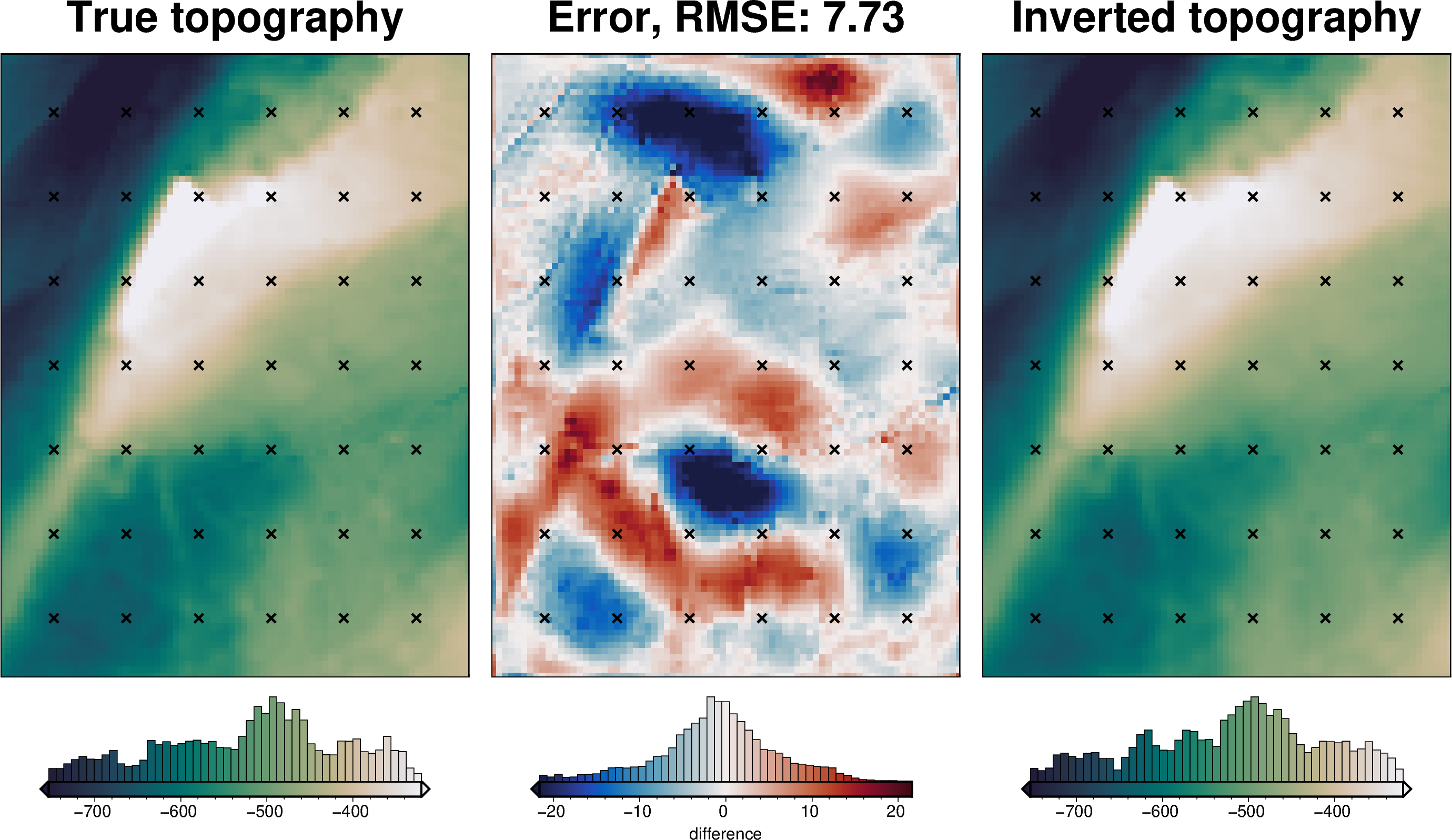
[34]:
plotting.plot_inversion_results(
grav_results,
topo_results,
parameters,
inversion_region,
iters_to_plot=2,
plot_iter_results=True,
plot_topo_results=True,
plot_grav_results=True,
)
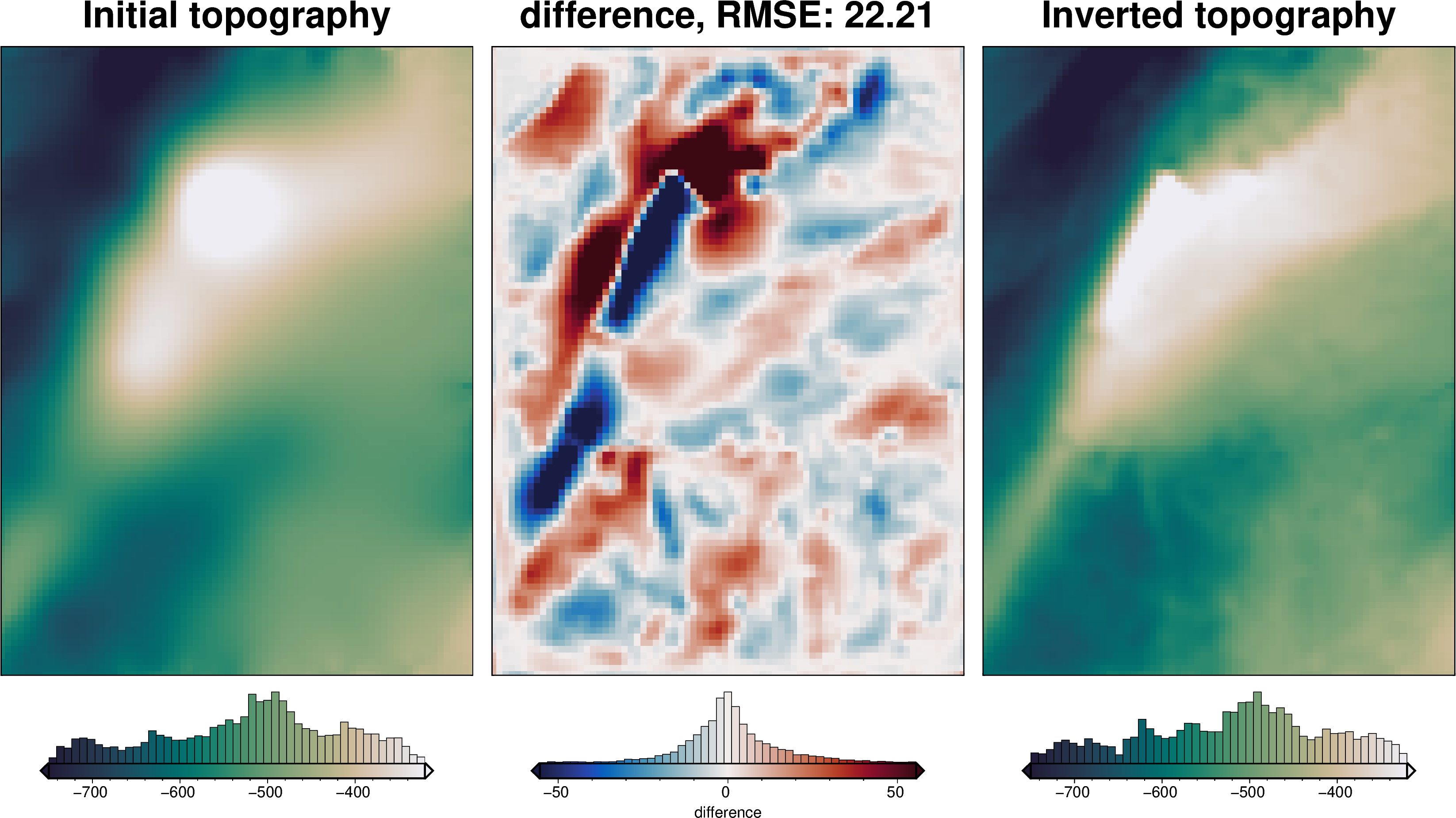
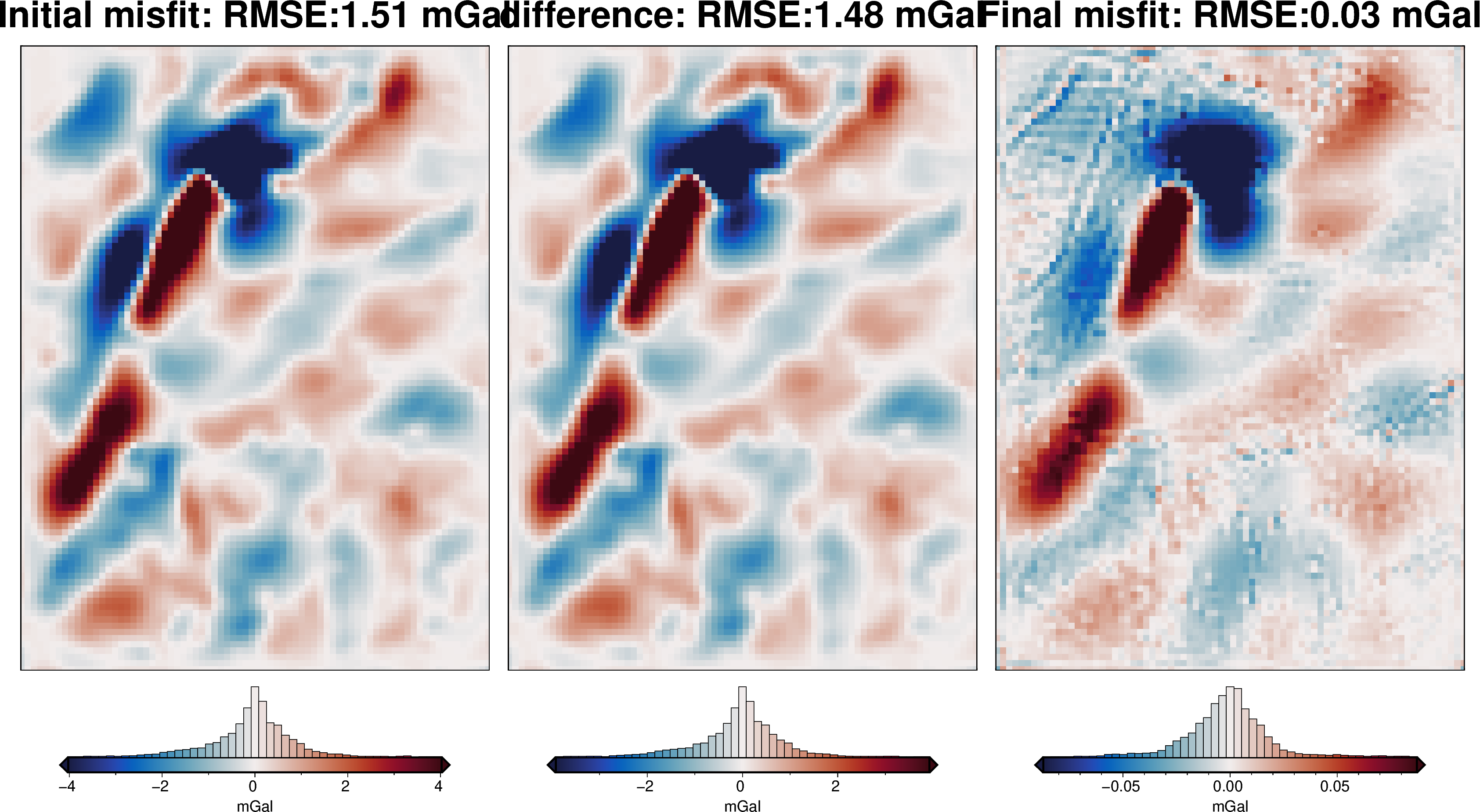
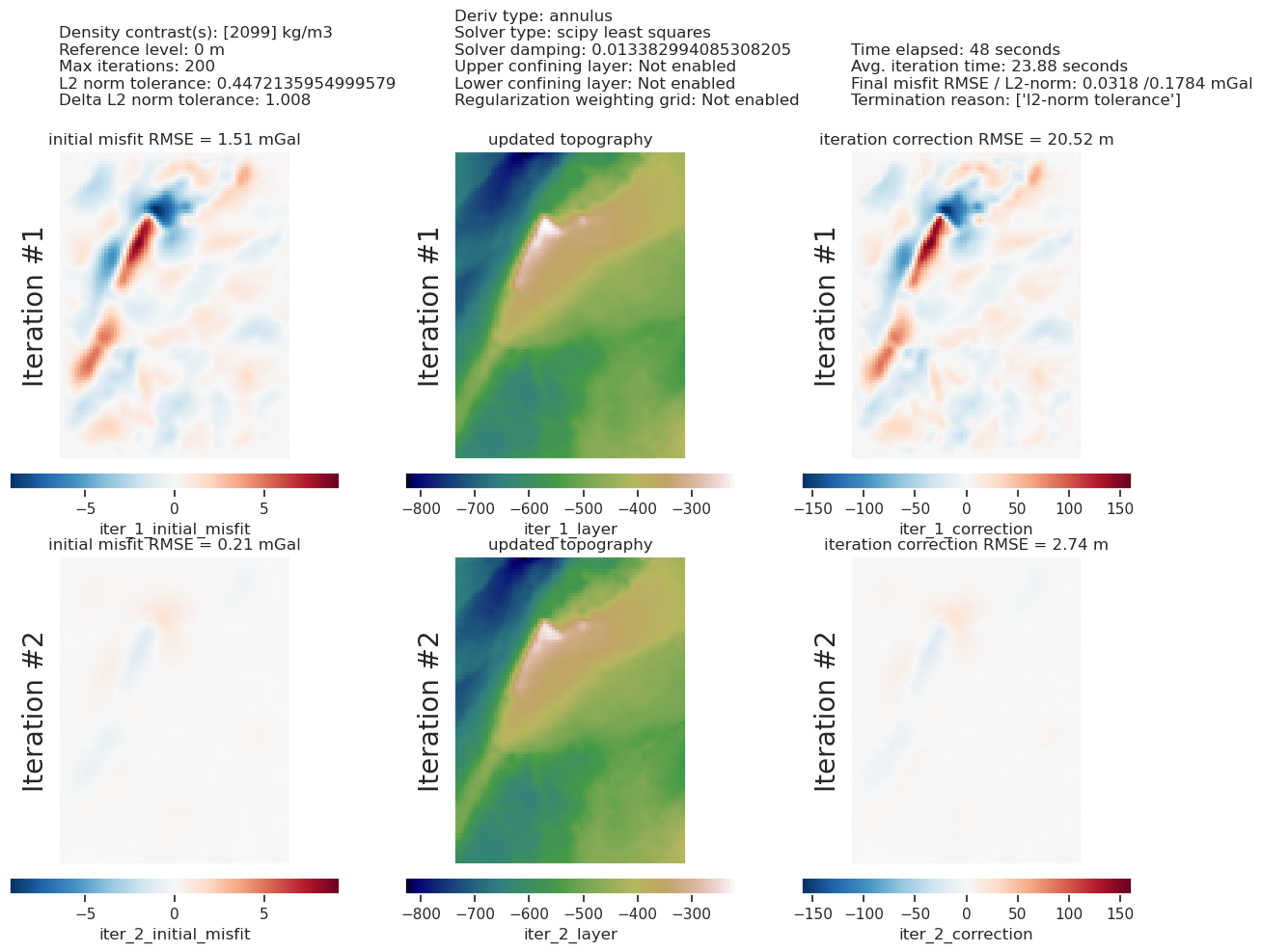
[35]:
# sample the inverted topography at the constraint points
constraint_points = utils.sample_grids(
constraint_points,
final_topography,
"inverted_topography",
coord_names=("easting", "northing"),
)
rmse = utils.rmse(constraint_points.upward - constraint_points.inverted_topography)
print(f"RMSE: {rmse:.2f} m")
RMSE: 3.54 m
[36]:
# save to csv
constraint_points.to_csv(f"{fpath}_constraint_points.csv", index=False)
[37]:
constraint_points = pd.read_csv(f"{fpath}_constraint_points.csv")
constraint_points
[37]:
| northing | easting | inside | true_upward | upward | starting_bathymetry | dif | inverted_topography | |
|---|---|---|---|---|---|---|---|---|
| 0 | -1.600000e+06 | -4.000000e+04 | False | -601.093994 | -601.093994 | -601.093994 | 0.000000 | -611.293152 |
| 1 | -1.600000e+06 | -3.800000e+04 | False | -609.216919 | -609.216919 | -609.216919 | 0.000000 | -607.129700 |
| 2 | -1.600000e+06 | -3.600000e+04 | False | -616.355957 | -616.355957 | -616.355957 | 0.000000 | -609.253174 |
| 3 | -1.600000e+06 | -3.400000e+04 | False | -621.262268 | -621.262268 | -621.262268 | 0.000000 | -610.899475 |
| 4 | -1.600000e+06 | -3.200000e+04 | False | -625.510925 | -625.510925 | -625.510925 | 0.000000 | -614.510315 |
| ... | ... | ... | ... | ... | ... | ... | ... | ... |
| 881 | -1.418571e+06 | -3.637979e-12 | True | -747.305711 | -747.305711 | -747.289192 | -0.016520 | -733.876385 |
| 882 | -1.418571e+06 | 2.333333e+04 | True | -619.672055 | -619.672055 | -619.459742 | -0.212313 | -597.901453 |
| 883 | -1.418571e+06 | 4.666667e+04 | True | -505.761536 | -505.761536 | -505.739808 | -0.021728 | -497.452503 |
| 884 | -1.418571e+06 | 7.000000e+04 | True | -447.753091 | -447.753091 | -447.782831 | 0.029740 | -456.295524 |
| 885 | -1.418571e+06 | 9.333333e+04 | True | -395.004206 | -395.004206 | -395.079663 | 0.075456 | -387.897039 |
886 rows × 8 columns
Redo regional separation with true density
[38]:
density_grid = xr.where(
starting_bathymetry >= zref,
true_density_contrast,
-true_density_contrast,
)
# create layer of prisms
starting_prisms_true = utils.grids_to_prisms(
starting_bathymetry,
zref,
density=density_grid,
)
grav_df_true_density = grav_df.copy()
grav_df_true_density["starting_gravity"] = starting_prisms_true.prism_layer.gravity(
coordinates=(
grav_df_true_density.easting,
grav_df_true_density.northing,
grav_df_true_density.upward,
),
field="g_z",
progressbar=True,
)
# temporarily set some kwargs
true_density_reg_kwargs = copy.deepcopy(regional_grav_kwargs)
true_density_reg_kwargs["cv_kwargs"]["fname"] = (
"../tmp_outputs/Ross_Sea_04_regional_sep_true_density"
)
true_density_reg_kwargs["cv_kwargs"]["progressbar"] = True
grav_df_true_density = regional.regional_separation(
grav_df=grav_df_true_density,
**true_density_reg_kwargs,
)
regional_comparison(grav_df_true_density)
[39]:
# run the inversion workflow
inversion_results = inversion.run_inversion_workflow(
grav_df=grav_df_true_density,
fname=f"{fpath}_true_density",
starting_prisms=starting_prisms_true,
plot_dynamic_convergence=True,
**kwargs,
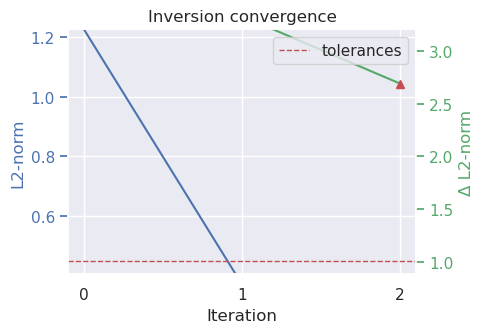
)
[40]:
# load saved inversion results
with pathlib.Path(f"{fpath}_true_density_results.pickle").open("rb") as f:
inversion_results = pickle.load(f)
# collect the results
topo_results, grav_results, parameters, elapsed_time = inversion_results
final_topography = topo_results.set_index(["northing", "easting"]).to_xarray().topo
[41]:
plotting.plot_inversion_results(
grav_results,
topo_results,
parameters,
inversion_region,
iters_to_plot=2,
plot_iter_results=True,
plot_topo_results=True,
plot_grav_results=True,
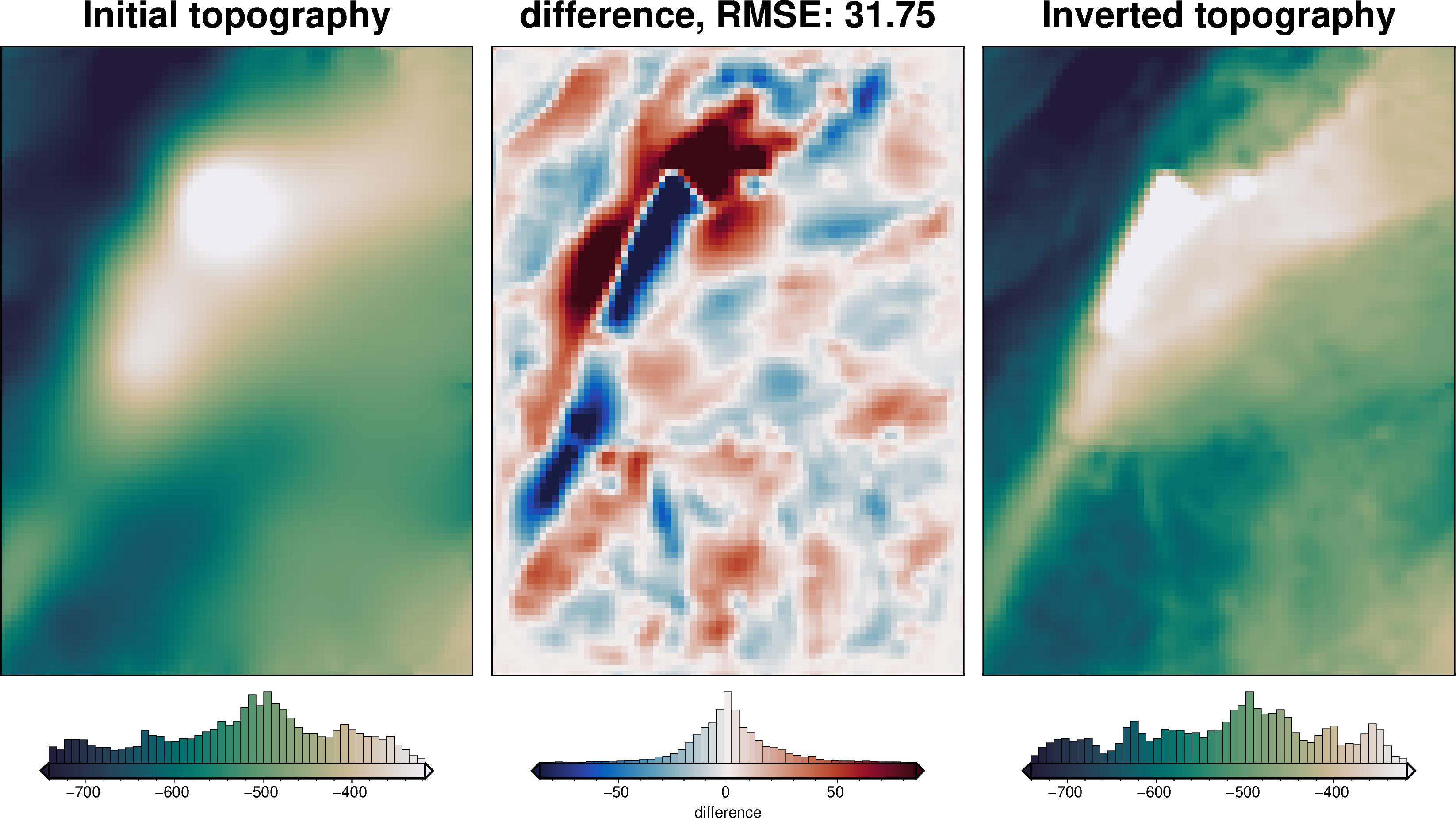
)
_ = polar_utils.grd_compare(
bathymetry,
final_topography,
region=inversion_region,
plot=True,
grid1_name="True topography",
grid2_name="Inverted topography",
robust=True,
hist=True,
inset=False,
verbose="q",
title="difference",
grounding_line=False,
reverse_cpt=True,
cmap="rain",
points=constraint_points[constraint_points.inside],
points_style="x.2c",
)
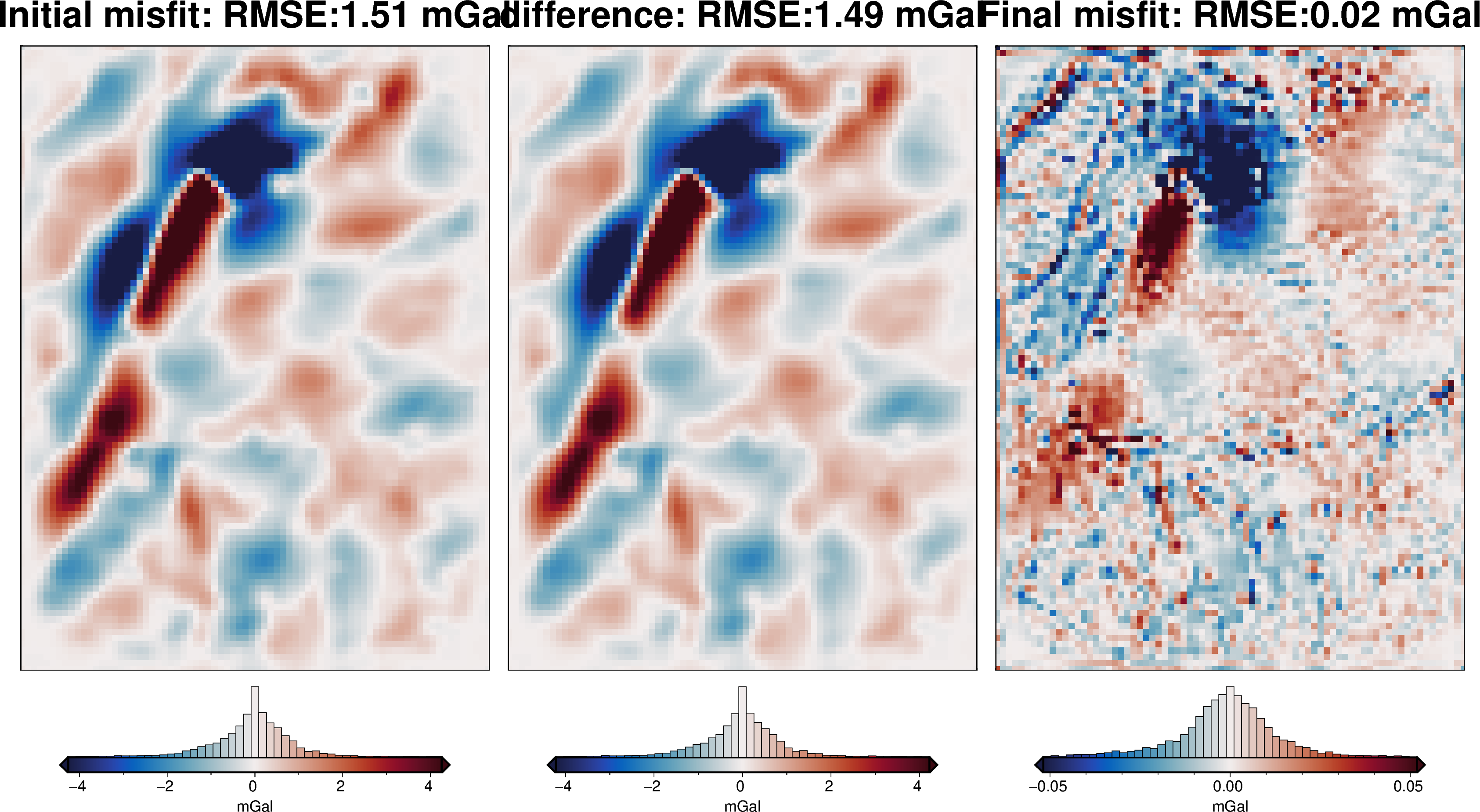
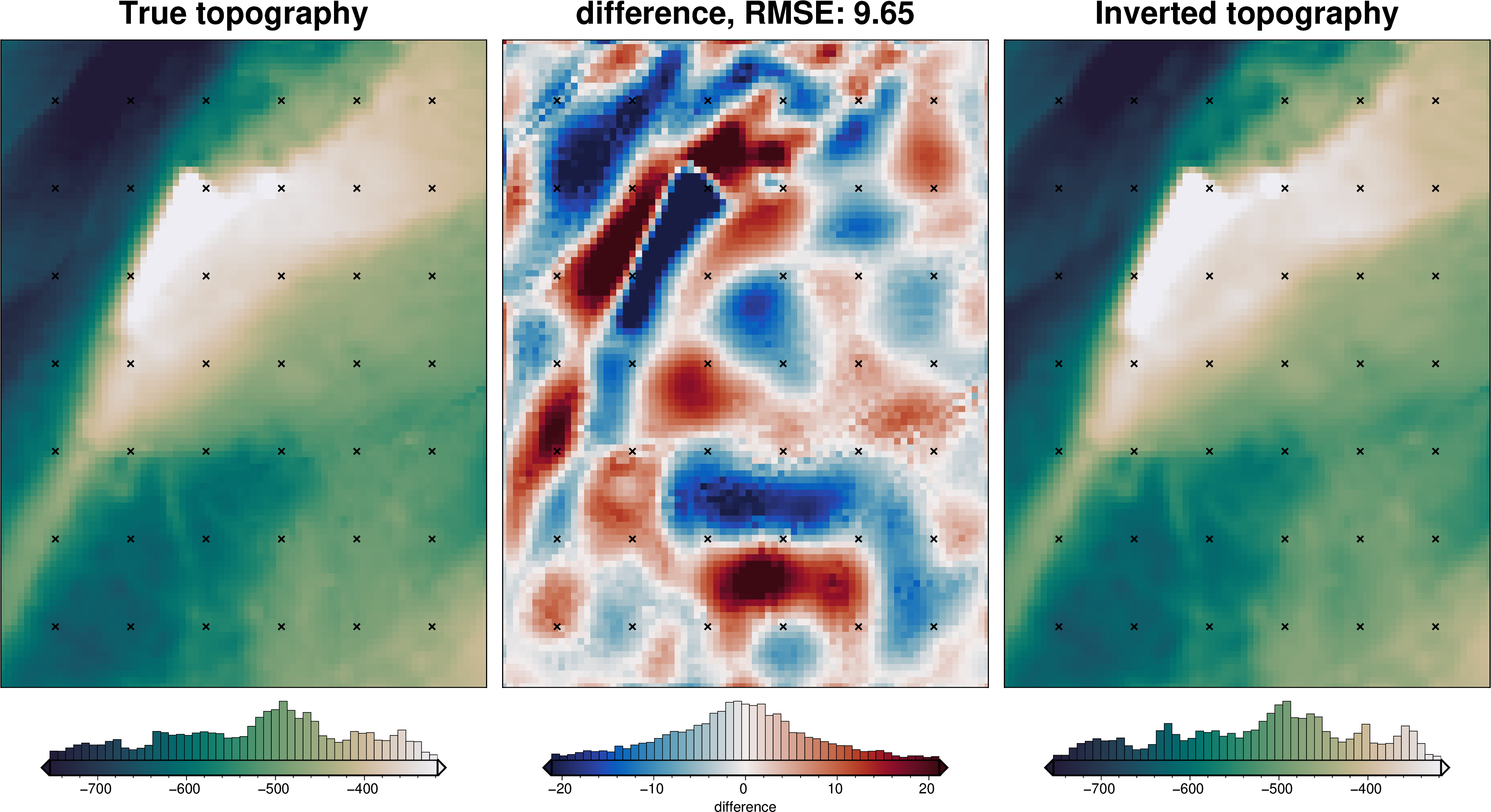
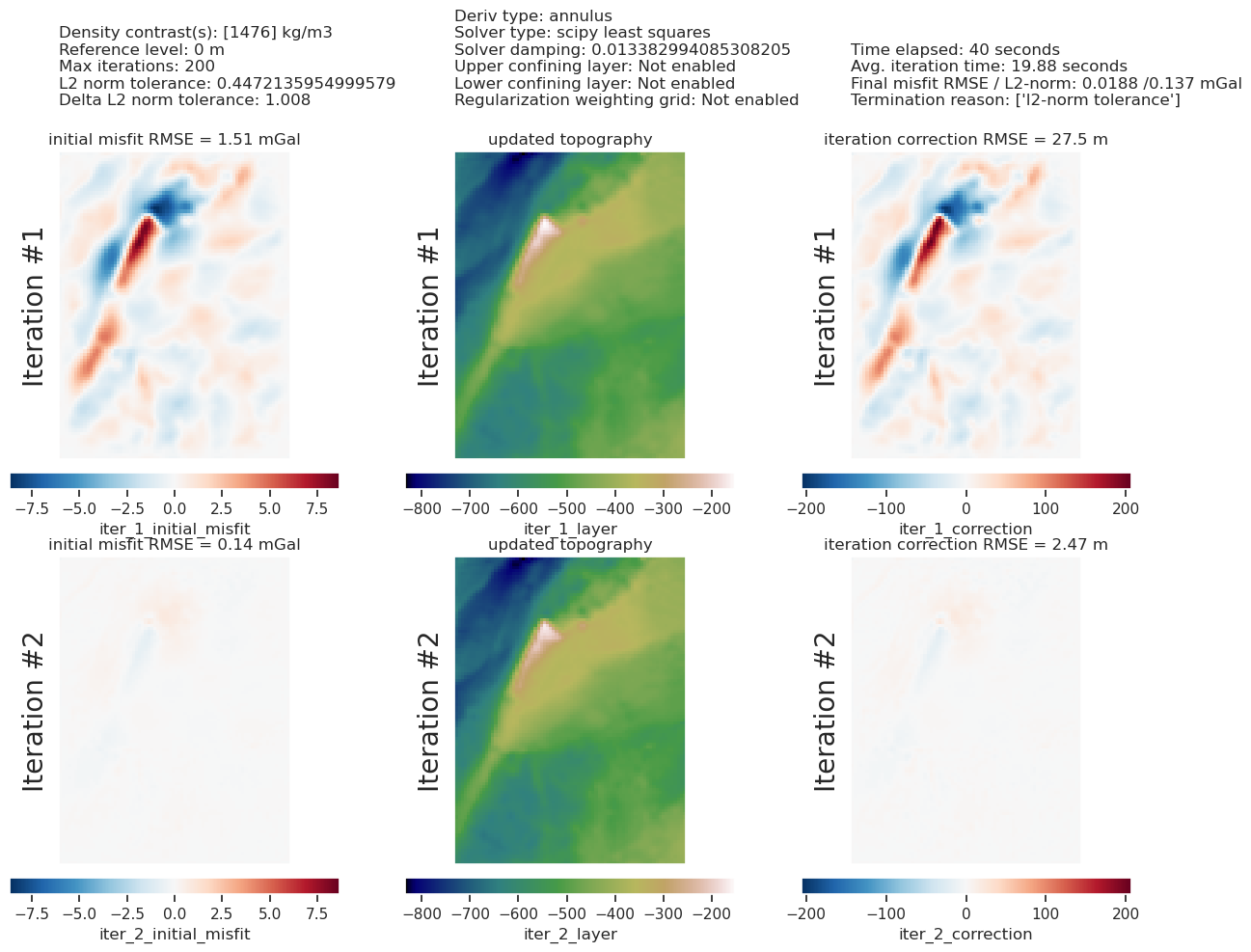
[ ]:
# re-load the study from the saved pickle file
with pathlib.Path(
f"{true_density_reg_kwargs.get('cv_kwargs').get('fname')}.pickle"
).open("rb") as f:
study = pickle.load(f)
reg_eq_depth = min(study.best_trials, key=lambda t: t.values[0]).params["depth"] # noqa: PD011
reg_eq_damping = None
new_true_density_reg_kwargs = dict(
method="constraints",
grid_method="eq_sources",
constraints_df=constraint_points,
damping=reg_eq_damping,
depth=reg_eq_depth,
block_size=None,
)
reg_eq_depth, reg_eq_damping
(214284.78608580318, None)
[43]:
grav_df_true_density
[43]:
| northing | easting | upward | bathymetry_grav | basement_grav_normalized | basement_grav | gravity_anomaly | starting_gravity | true_res | misfit | reg | res | |
|---|---|---|---|---|---|---|---|---|---|---|---|---|
| 0 | -1600000.0 | -40000.0 | 1000.0 | -35.551054 | -0.575610 | -36.298772 | -71.849826 | -35.578561 | -3.009687 | -36.271265 | -36.352514 | 0.081249 |
| 1 | -1600000.0 | -38000.0 | 1000.0 | -36.054657 | -0.523194 | -33.940048 | -69.994704 | -36.042642 | -3.088826 | -33.952063 | -33.935629 | -0.016434 |
| 2 | -1600000.0 | -36000.0 | 1000.0 | -36.473146 | -0.466341 | -31.381660 | -67.854806 | -36.460095 | -3.125498 | -31.394711 | -31.343652 | -0.051059 |
| 3 | -1600000.0 | -34000.0 | 1000.0 | -36.755608 | -0.406001 | -28.666395 | -65.422003 | -36.784649 | -3.111113 | -28.637354 | -28.615142 | -0.022212 |
| 4 | -1600000.0 | -32000.0 | 1000.0 | -36.951029 | -0.343146 | -25.837899 | -62.788928 | -36.998469 | -3.110966 | -25.790460 | -25.788302 | -0.002158 |
| ... | ... | ... | ... | ... | ... | ... | ... | ... | ... | ... | ... | ... |
| 7671 | -1400000.0 | 102000.0 | 1000.0 | -25.760090 | 0.399165 | 7.566093 | -18.193997 | -25.498180 | -2.438584 | 7.304183 | 7.321185 | -0.017002 |
| 7672 | -1400000.0 | 104000.0 | 1000.0 | -25.911429 | 0.334795 | 4.669468 | -21.241961 | -25.673780 | -2.429314 | 4.431819 | 4.418937 | 0.012882 |
| 7673 | -1400000.0 | 106000.0 | 1000.0 | -26.032814 | 0.268739 | 1.696911 | -24.335902 | -25.808792 | -2.427211 | 1.472890 | 1.429781 | 0.043108 |
| 7674 | -1400000.0 | 108000.0 | 1000.0 | -26.121903 | 0.201713 | -1.319231 | -27.441134 | -25.904533 | -2.428732 | -1.536601 | -1.582007 | 0.045406 |
| 7675 | -1400000.0 | 110000.0 | 1000.0 | -26.206160 | 0.134416 | -4.347629 | -30.553790 | -25.981733 | -2.442380 | -4.572057 | -4.536543 | -0.035514 |
7676 rows × 12 columns
[44]:
regional_misfit_parameter_dict = {
"depth": {
"distribution": "normal",
"loc": reg_eq_depth, # mean
"scale": reg_eq_depth / 4, # standard deviation
},
}
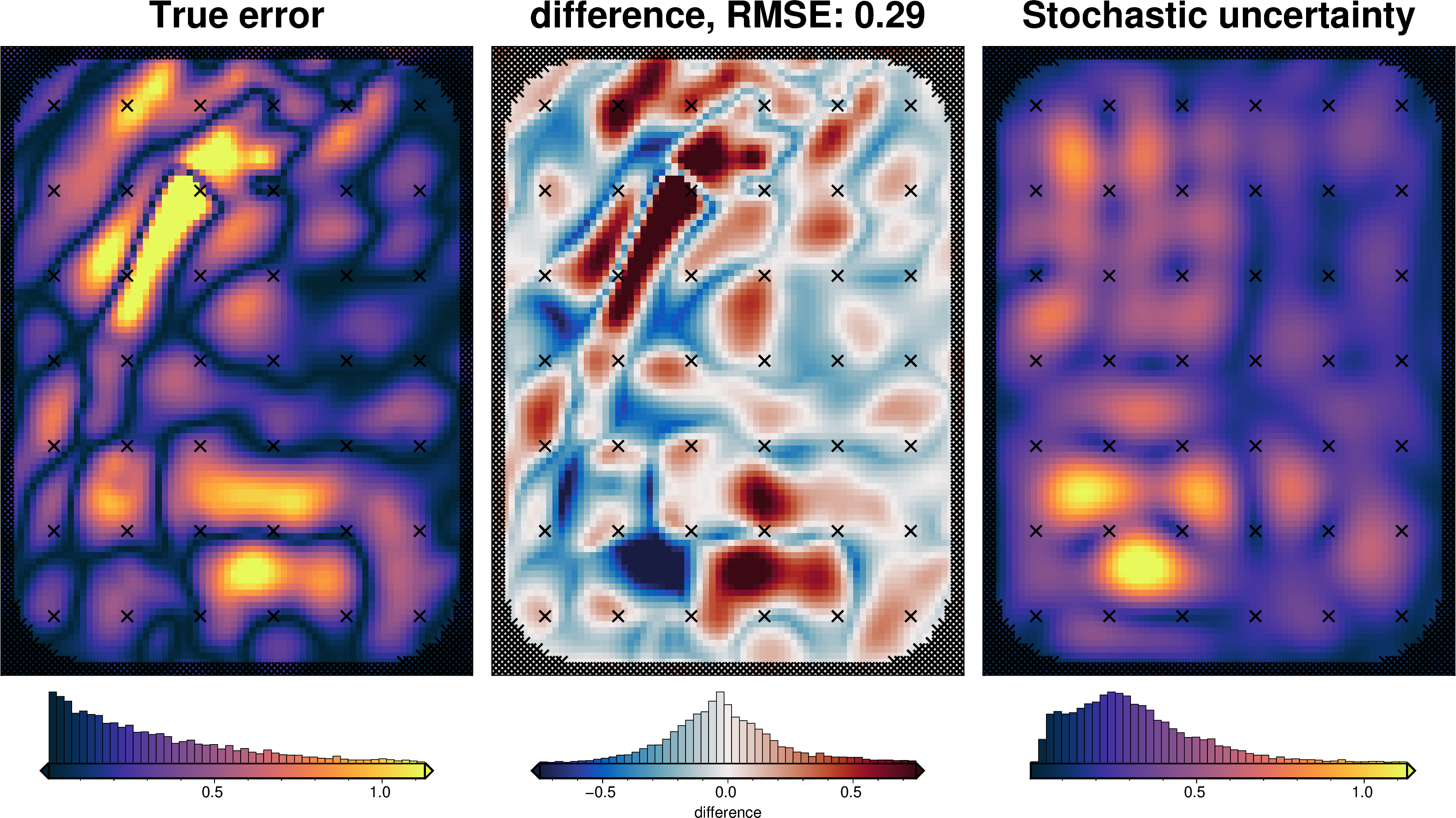
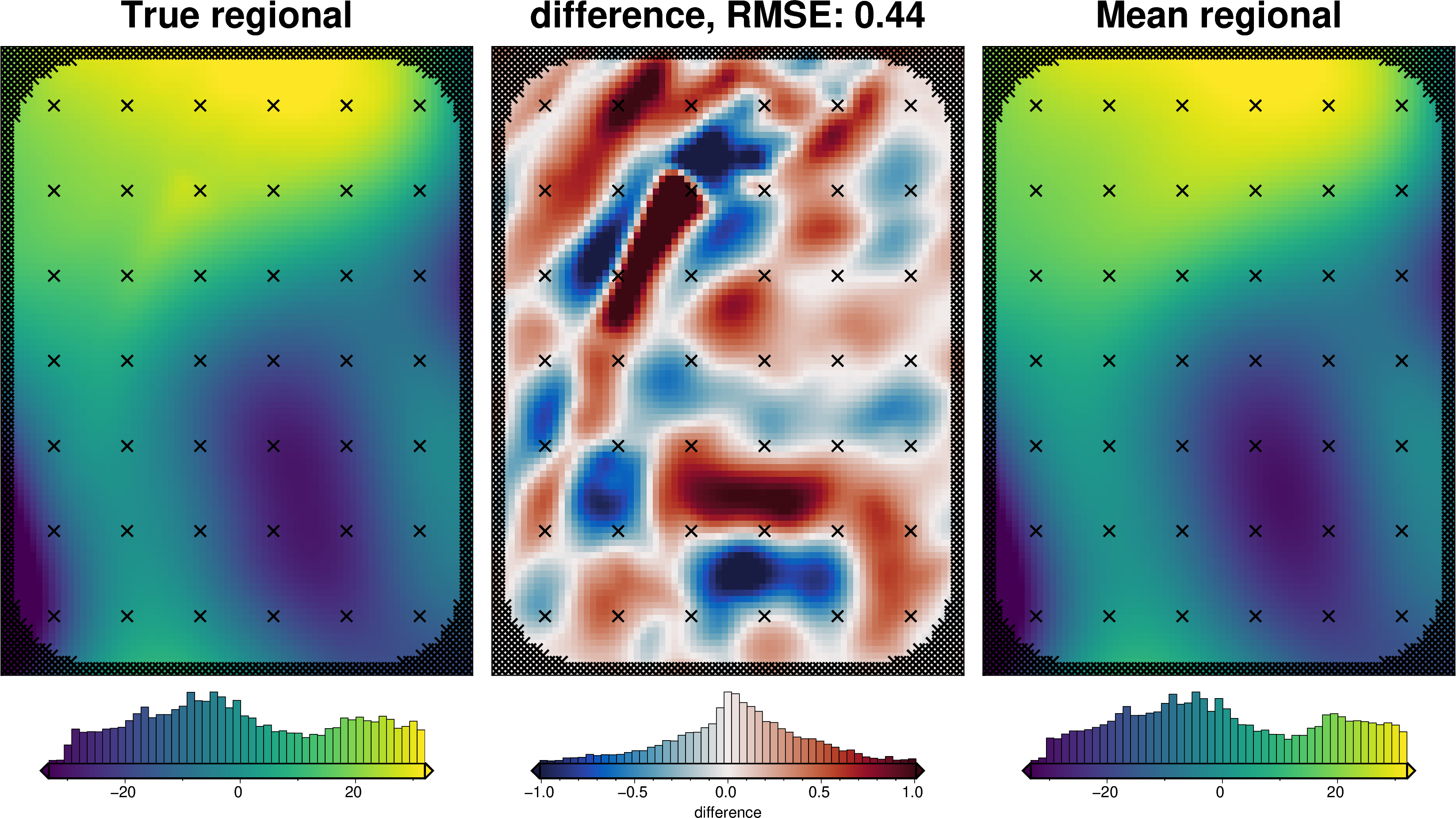
regional_misfit_stats, _ = uncertainty.regional_misfit_uncertainty(
runs=20,
parameter_dict=regional_misfit_parameter_dict,
plot_region=inversion_region,
true_regional=grav_df_true_density.set_index(["northing", "easting"])
.to_xarray()
.basement_grav,
weight_by="constraints",
# weight_by=None,
grav_df=grav_df_true_density,
**new_true_density_reg_kwargs,
)
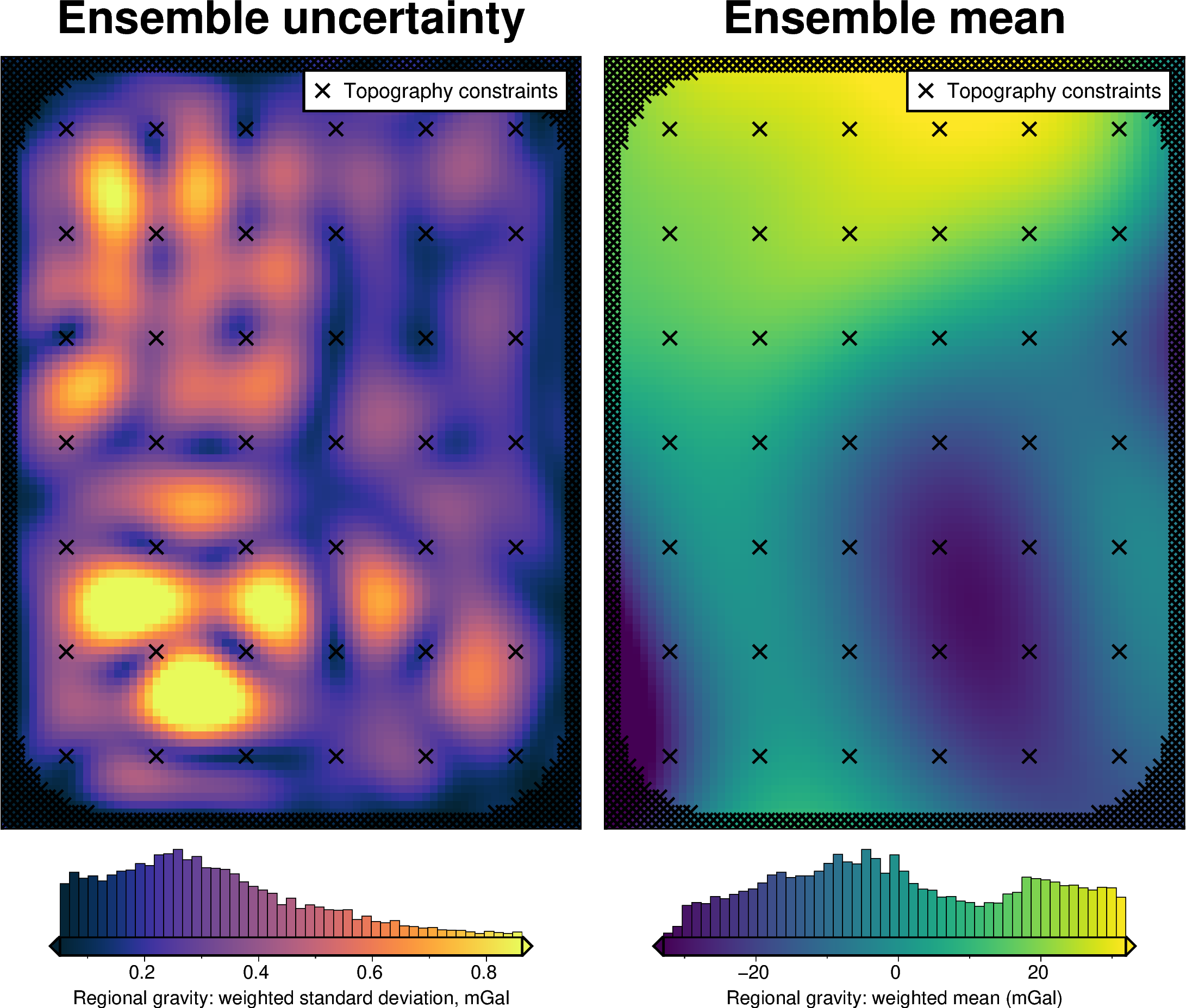
[45]:
grav_grid = grav_df_true_density.set_index(["northing", "easting"]).to_xarray()
grav_grid["reg_uncert"] = regional_misfit_stats.z_stdev
grav_df_true_density = vd.grid_to_table(grav_grid)
grav_df_true_density
[45]:
| northing | easting | upward | bathymetry_grav | basement_grav_normalized | basement_grav | gravity_anomaly | starting_gravity | true_res | misfit | reg | res | reg_uncert | |
|---|---|---|---|---|---|---|---|---|---|---|---|---|---|
| 0 | -1600000.0 | -40000.0 | 1000.0 | -35.551054 | -0.575610 | -36.298772 | -71.849826 | -35.578561 | -3.009687 | -36.271265 | -36.352514 | 0.081249 | 0.196374 |
| 1 | -1600000.0 | -38000.0 | 1000.0 | -36.054657 | -0.523194 | -33.940048 | -69.994704 | -36.042642 | -3.088826 | -33.952063 | -33.935629 | -0.016434 | 0.082311 |
| 2 | -1600000.0 | -36000.0 | 1000.0 | -36.473146 | -0.466341 | -31.381660 | -67.854806 | -36.460095 | -3.125498 | -31.394711 | -31.343652 | -0.051059 | 0.058318 |
| 3 | -1600000.0 | -34000.0 | 1000.0 | -36.755608 | -0.406001 | -28.666395 | -65.422003 | -36.784649 | -3.111113 | -28.637354 | -28.615142 | -0.022212 | 0.076759 |
| 4 | -1600000.0 | -32000.0 | 1000.0 | -36.951029 | -0.343146 | -25.837899 | -62.788928 | -36.998469 | -3.110966 | -25.790460 | -25.788302 | -0.002158 | 0.084586 |
| ... | ... | ... | ... | ... | ... | ... | ... | ... | ... | ... | ... | ... | ... |
| 7671 | -1400000.0 | 102000.0 | 1000.0 | -25.760090 | 0.399165 | 7.566093 | -18.193997 | -25.498180 | -2.438584 | 7.304183 | 7.321185 | -0.017002 | 0.182931 |
| 7672 | -1400000.0 | 104000.0 | 1000.0 | -25.911429 | 0.334795 | 4.669468 | -21.241961 | -25.673780 | -2.429314 | 4.431819 | 4.418937 | 0.012882 | 0.197329 |
| 7673 | -1400000.0 | 106000.0 | 1000.0 | -26.032814 | 0.268739 | 1.696911 | -24.335902 | -25.808792 | -2.427211 | 1.472890 | 1.429781 | 0.043108 | 0.171544 |
| 7674 | -1400000.0 | 108000.0 | 1000.0 | -26.121903 | 0.201713 | -1.319231 | -27.441134 | -25.904533 | -2.428732 | -1.536601 | -1.582007 | 0.045406 | 0.089063 |
| 7675 | -1400000.0 | 110000.0 | 1000.0 | -26.206160 | 0.134416 | -4.347629 | -30.553790 | -25.981733 | -2.442380 | -4.572057 | -4.536543 | -0.035514 | 0.104078 |
7676 rows × 13 columns
[46]:
grav_df_true_density.to_csv(f"{fpath}_grav_df_true_density.csv", index=False)
Uncertainty analysis
Inversion error
[47]:
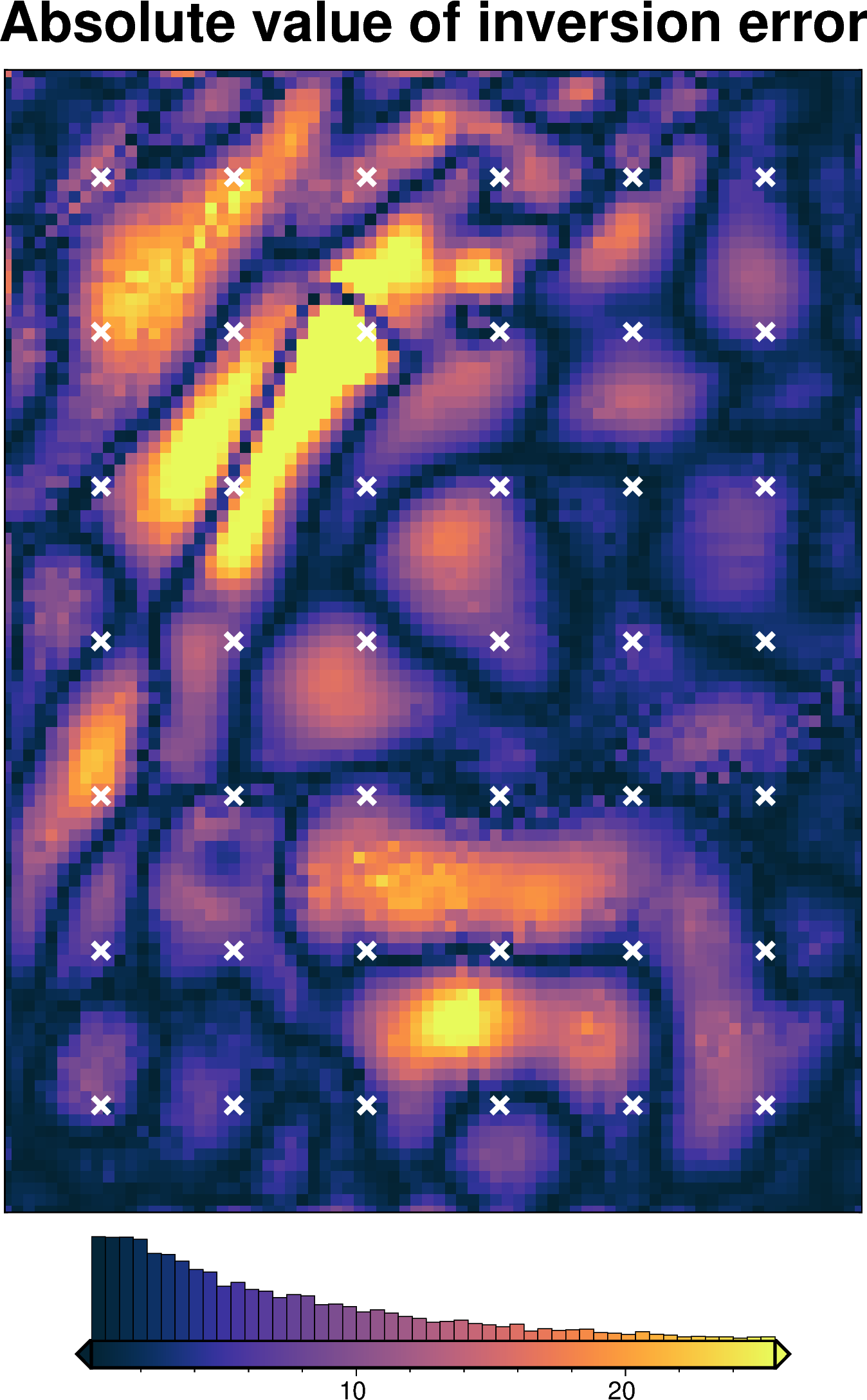
inversion_error = np.abs(bathymetry - final_topography)
fig = maps.plot_grd(
inversion_error,
region=inversion_region,
hist=True,
cmap="thermal",
title="Absolute value of inversion error",
robust=True,
points=constraint_points[constraint_points.inside],
points_style="x.3c",
points_fill="white",
points_pen="2p",
)
fig.show()
[ ]:
# re-load the study from the saved pickle file
with pathlib.Path(f"{regional_grav_kwargs.get('cv_kwargs').get('fname')}.pickle").open(
"rb"
) as f:
study = pickle.load(f)
reg_eq_depth = min(study.best_trials, key=lambda t: t.values[0]).params["depth"] # noqa: PD011
reg_eq_damping = None
new_regional_grav_kwargs = dict(
method="constraints",
grid_method="eq_sources",
constraints_df=constraint_points,
damping=reg_eq_damping,
depth=reg_eq_depth,
block_size=None,
)
reg_eq_depth, reg_eq_damping
(280813.97890601715, None)
[49]:
# kwargs to reuse for all uncertainty analyses
uncert_kwargs = dict(
grav_df=grav_df,
density_contrast=best_density_contrast,
zref=zref,
starting_prisms=starting_prisms,
starting_topography=starting_bathymetry,
regional_grav_kwargs=new_regional_grav_kwargs,
**kwargs,
)
Solver damping component
[50]:
# load study
with pathlib.Path(f"{fpath}_damping_cv_damping_cv_study.pickle").open("rb") as f:
study = pickle.load(f)
study_df = study.trials_dataframe().drop(columns=["user_attrs_results"])
study_df = study_df.sort_values("value")
# calculate zscores of values
study_df["value_zscore"] = sp.stats.zscore(study_df["value"])
# drop outliers (values with zscore > |2|)
study_df2 = study_df[(np.abs(study_df.value_zscore) < 2)]
# pick damping standard deviation based on optimization
stdev = np.log10(study_df2.params_damping).std()
print(f"calculated stdev: {stdev}")
stdev = stdev / 2
print(f"using stdev: {stdev}")
calculated stdev: 0.4825312008020997
using stdev: 0.24126560040104986
[51]:
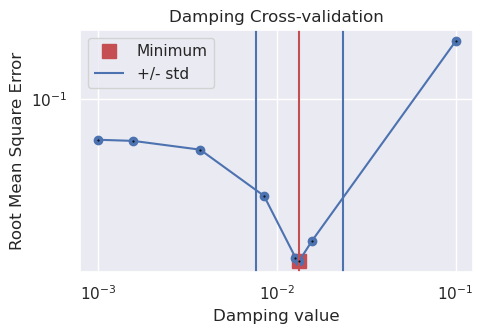
fig = plotting.plot_cv_scores(
study_df.value,
study_df.params_damping,
param_name="Damping",
logx=True,
logy=True,
)
ax = fig.axes[0]
best = float(study_df2.params_damping.iloc[0])
upper = float(10 ** (np.log10(best) + stdev))
lower = float(10 ** (np.log10(best) - stdev))
y_lims = ax.get_ylim()
ax.vlines(best, ymin=y_lims[0], ymax=y_lims[1], color="r")
ax.vlines(upper, ymin=y_lims[0], ymax=y_lims[1], label="+/- std")
ax.vlines(lower, ymin=y_lims[0], ymax=y_lims[1])
x_lims = ax.get_xlim()
ax.set_xlim(
min(x_lims[0], lower),
max(x_lims[1], upper),
)
ax.legend()
print("best:", best, "\nstd:", stdev, "\n+1std:", upper, "\n-1std:", lower)
best: 0.013382994085308205
std: 0.24126560040104986
+1std: 0.023324851444967345
-1std: 0.007678699738344471
[52]:
solver_dict = {
"solver_damping": {
"distribution": "normal",
"loc": np.log10(best_damping), # mean of base 10 exponent
"scale": stdev, # 0.2, # standard deviation of base 10 exponent
"log": True,
},
}
fname = f"{fpath}_uncertainty_damping"
# delete files if already exist
for p in pathlib.Path().glob(f"{fname}*"):
p.unlink(missing_ok=True)
uncert_damping_results = uncertainty.full_workflow_uncertainty_loop(
fname=fname,
runs=10,
parameter_dict=solver_dict,
**uncert_kwargs,
)
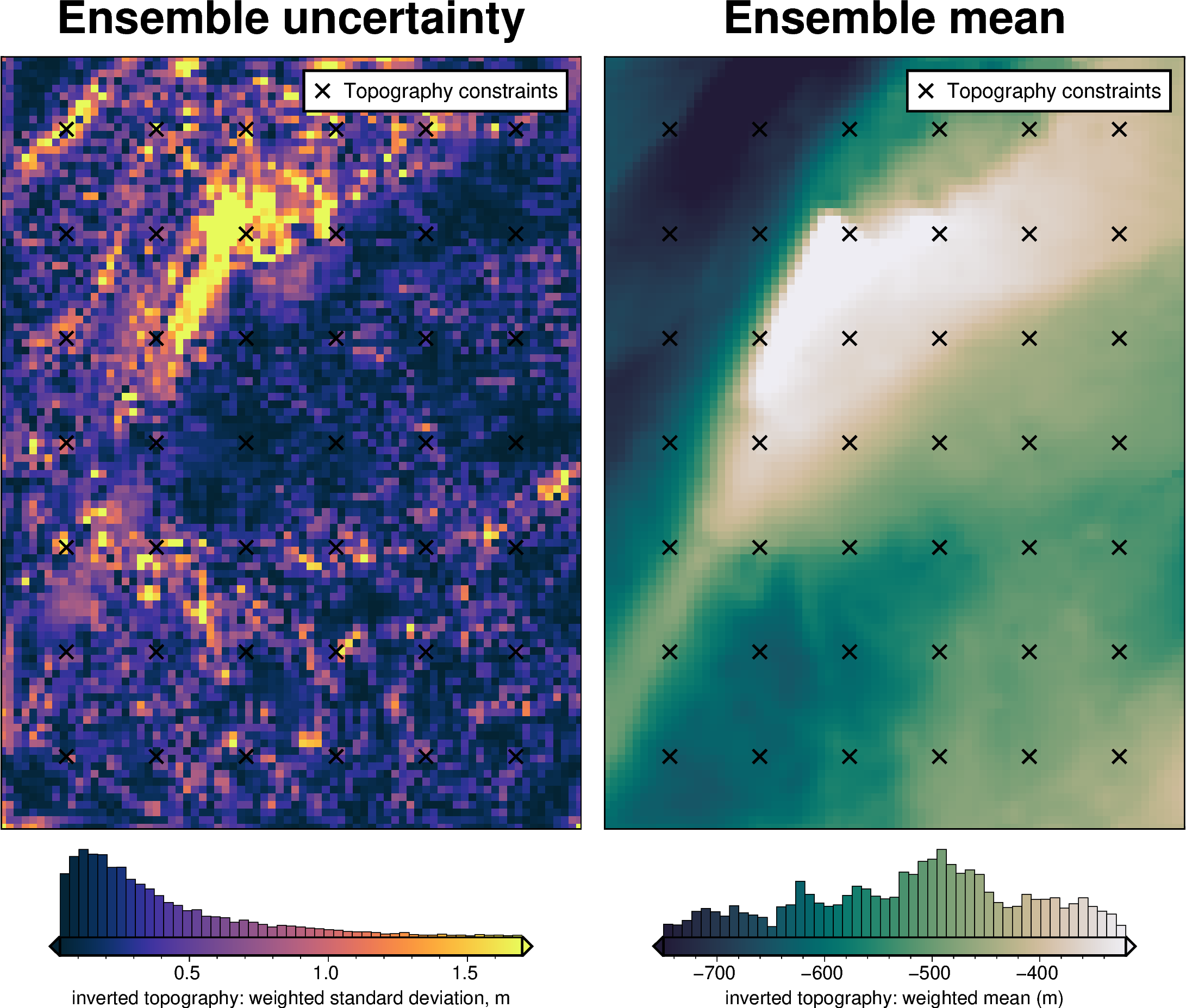
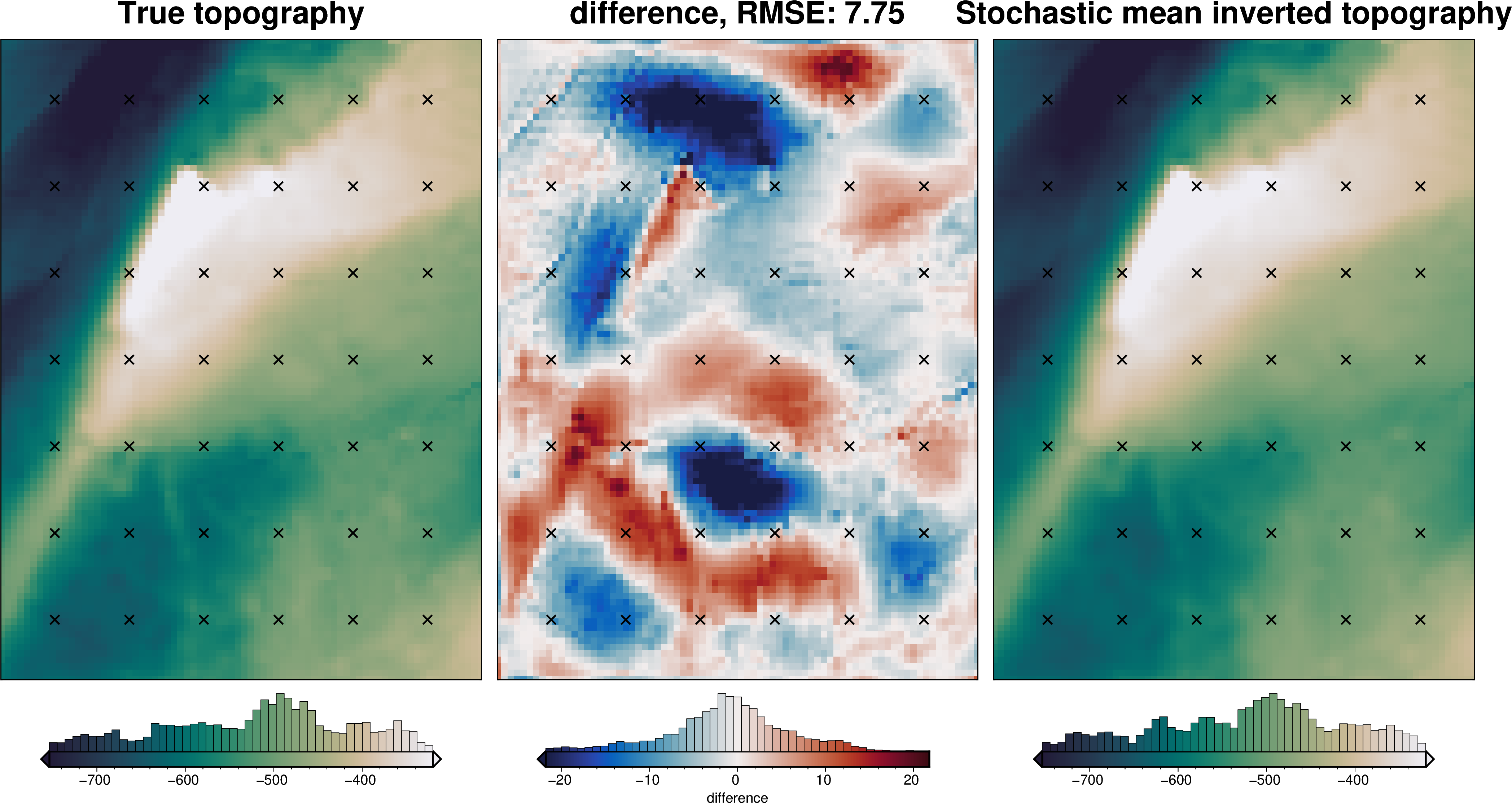
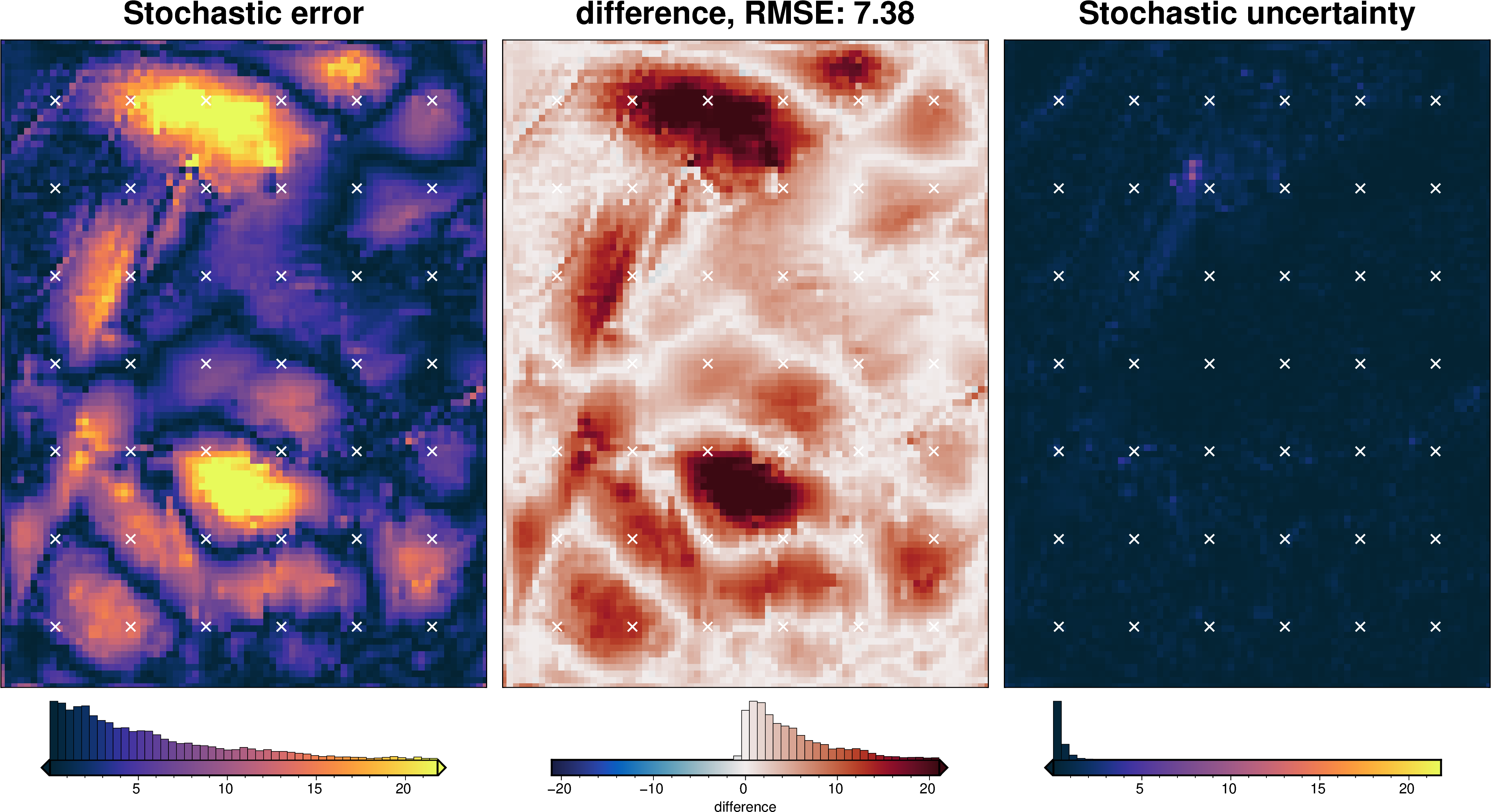
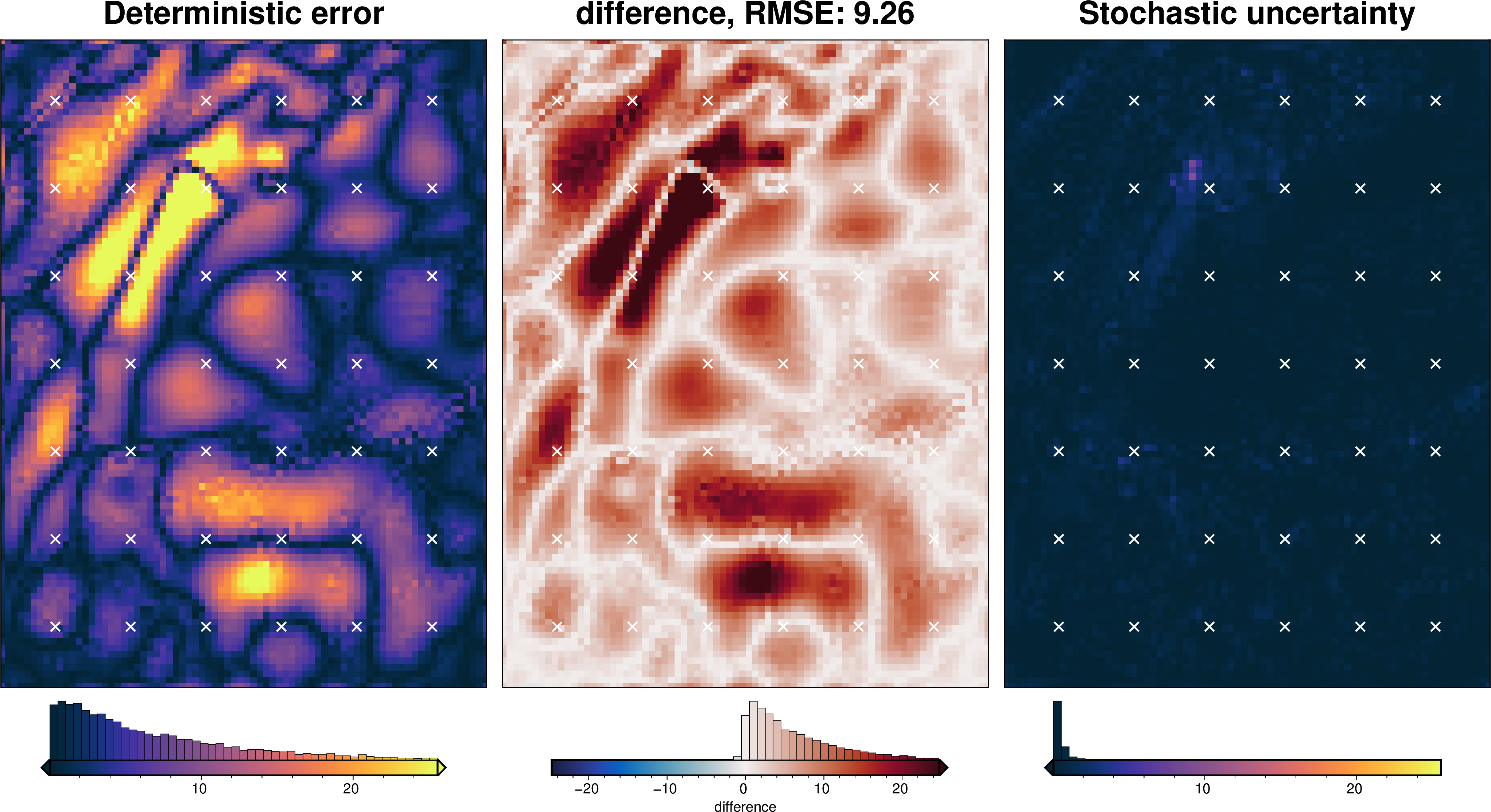
stats_ds = synth_plotting.uncert_plots(
uncert_damping_results,
inversion_region,
bathymetry,
deterministic_bathymetry=final_topography,
constraint_points=constraint_points[constraint_points.inside],
weight_by="constraints",
)
Density component
[53]:
# load study
with pathlib.Path(f"{fpath}_density_cv_kfolds_study.pickle").open("rb") as f:
study = pickle.load(f)
study_df = study.trials_dataframe()
study_df = study_df.sort_values("value")
# calculate zscores of values
study_df["value_zscore"] = sp.stats.zscore(study_df["value"])
# drop outliers (values with zscore > |2|)
study_df2 = study_df[(np.abs(study_df.value_zscore) < 2)]
stdev = study_df2.params_density_contrast.std()
print(f"calculated stdev: {stdev}")
# manually pick a stdev
stdev = 500
print(f"using stdev: {stdev}")
print(
f"density estimation error: {np.abs(true_density_contrast - best_density_contrast)}"
)
calculated stdev: 207.87211977996995
using stdev: 500
density estimation error: 623
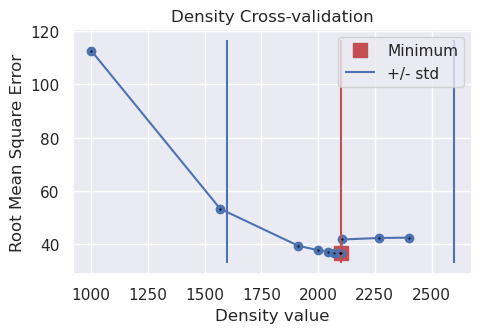
[ ]:
fig = plotting.plot_cv_scores(
study.trials_dataframe().value.to_numpy(),
study.trials_dataframe().params_density_contrast.values,
param_name="Density",
logx=False,
logy=False,
)
ax = fig.axes[0]
best = study_df2.params_density_contrast.iloc[0]
upper = best + stdev
lower = best - stdev
y_lims = ax.get_ylim()
ax.vlines(best, ymin=y_lims[0], ymax=y_lims[1], color="r")
ax.vlines(upper, ymin=y_lims[0], ymax=y_lims[1], label="+/- std")
ax.vlines(lower, ymin=y_lims[0], ymax=y_lims[1])
x_lims = ax.get_xlim()
ax.set_xlim(
min(x_lims[0], lower),
max(x_lims[1], upper),
)
ax.legend()
print("best:", best, "\nstd:", stdev, "\n+1std:", upper, "\n-1std:", lower)
best: 2099
std: 500
+1std: 2599
-1std: 1599
[55]:
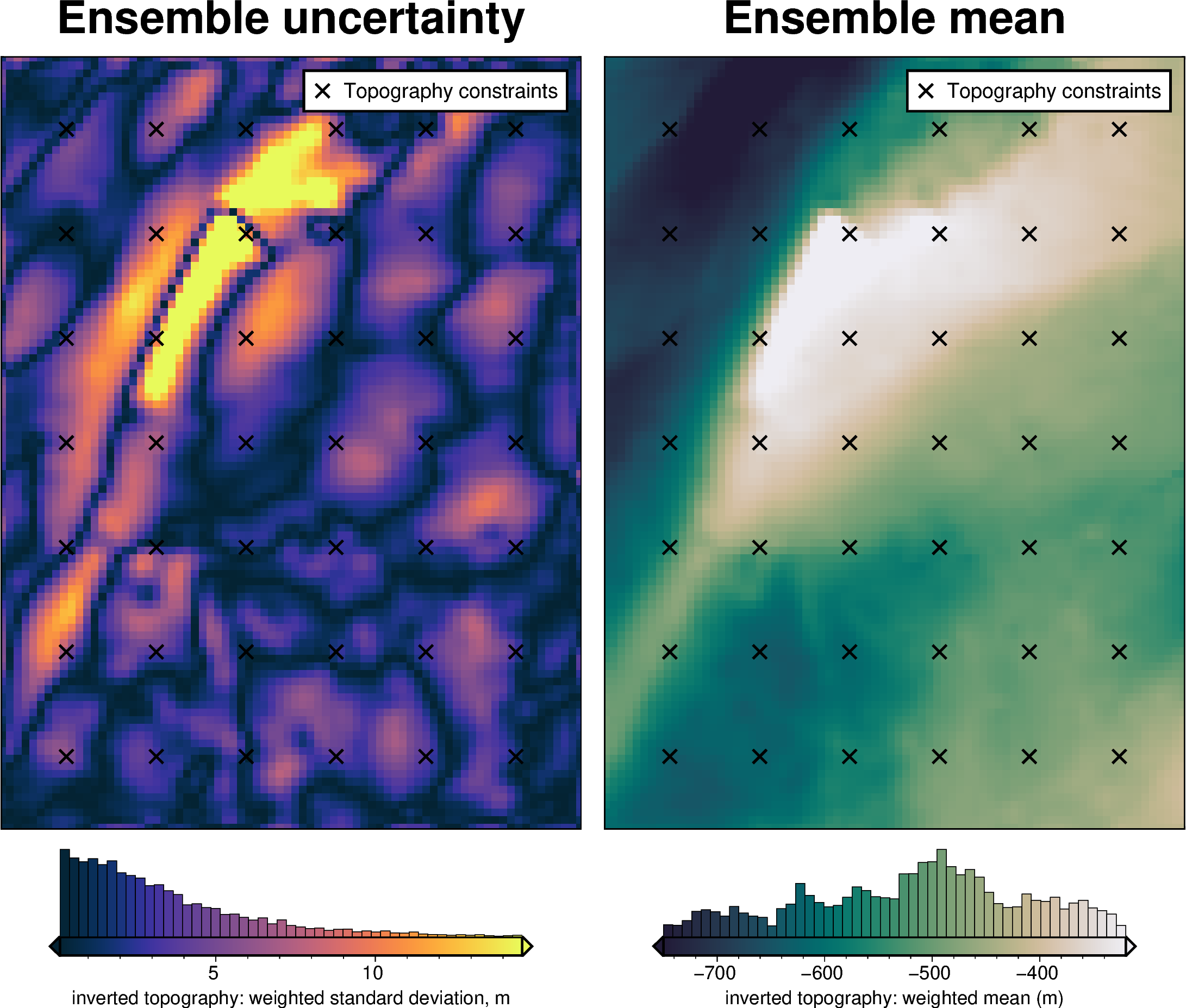
density_dict = {
"density_contrast": {
"distribution": "normal",
"loc": best_density_contrast,
"scale": stdev,
},
}
fname = f"{fpath}_uncertainty_density"
# delete files if already exist
for p in pathlib.Path().glob(f"{fname}*"):
p.unlink(missing_ok=True)
uncert_density_results = uncertainty.full_workflow_uncertainty_loop(
fname=fname,
runs=10,
parameter_dict=density_dict,
**uncert_kwargs,
)
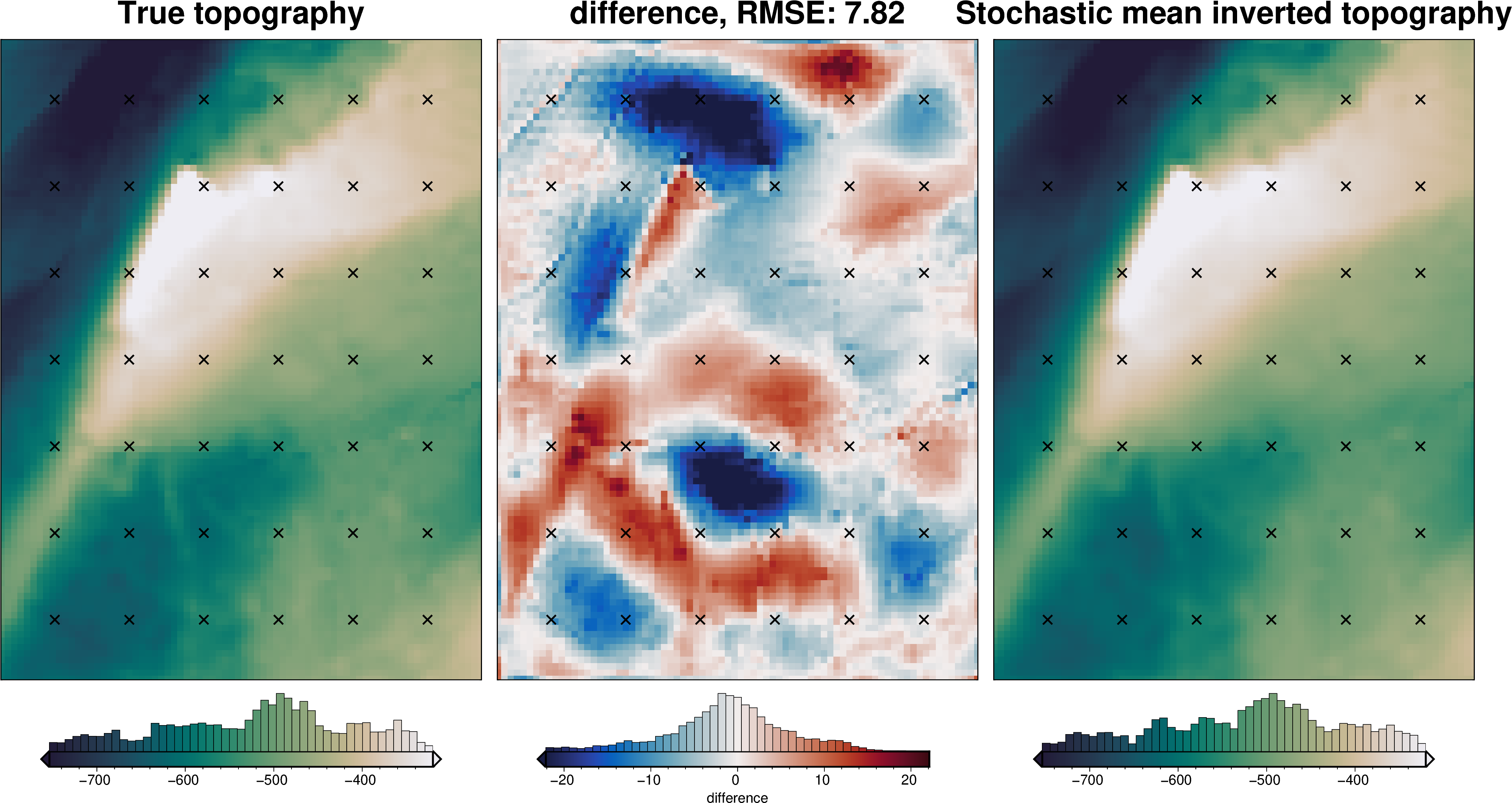
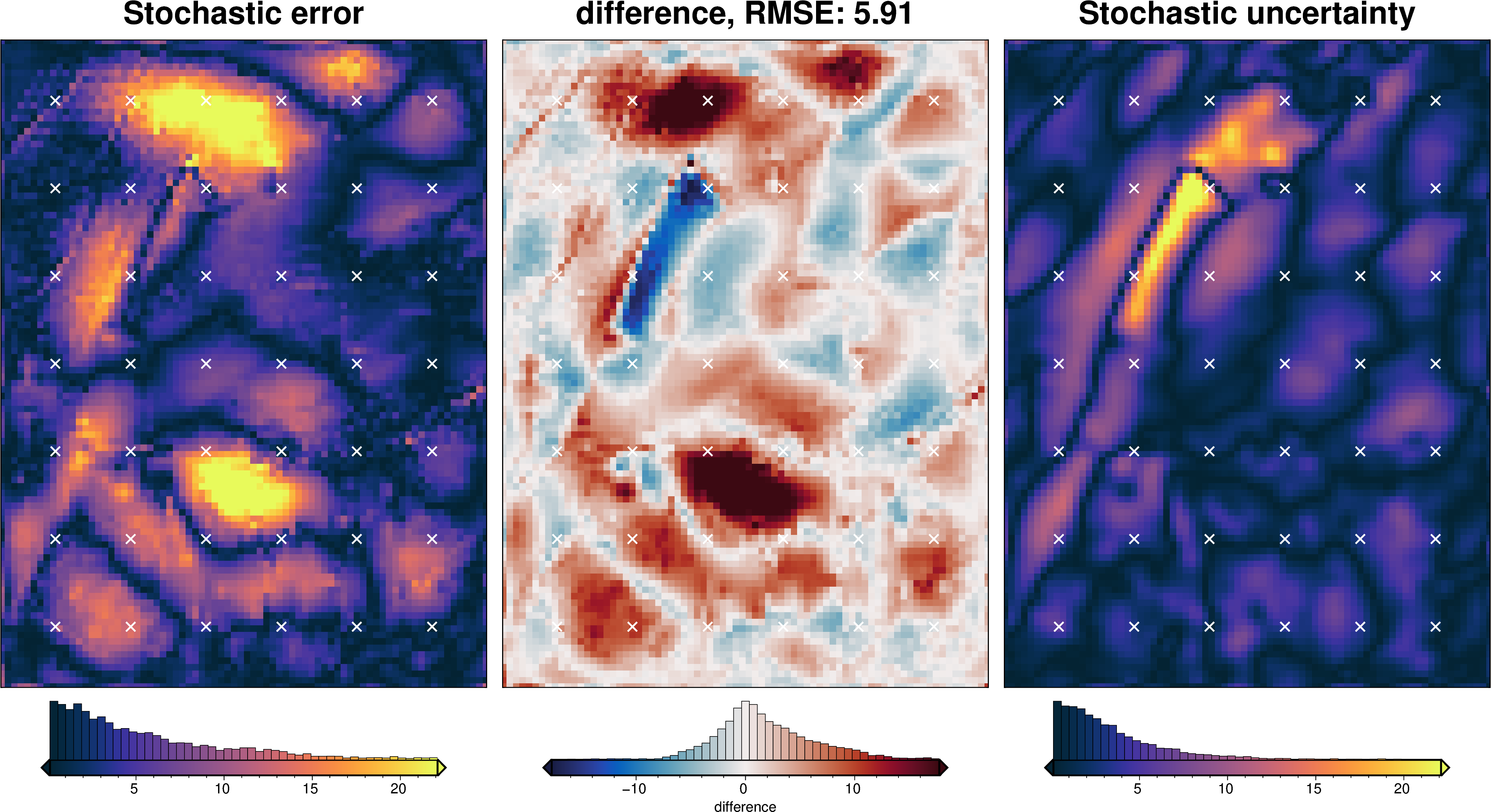
stats_ds = synth_plotting.uncert_plots(
uncert_density_results,
inversion_region,
bathymetry,
deterministic_bathymetry=final_topography,
constraint_points=constraint_points[constraint_points.inside],
weight_by="constraints",
)
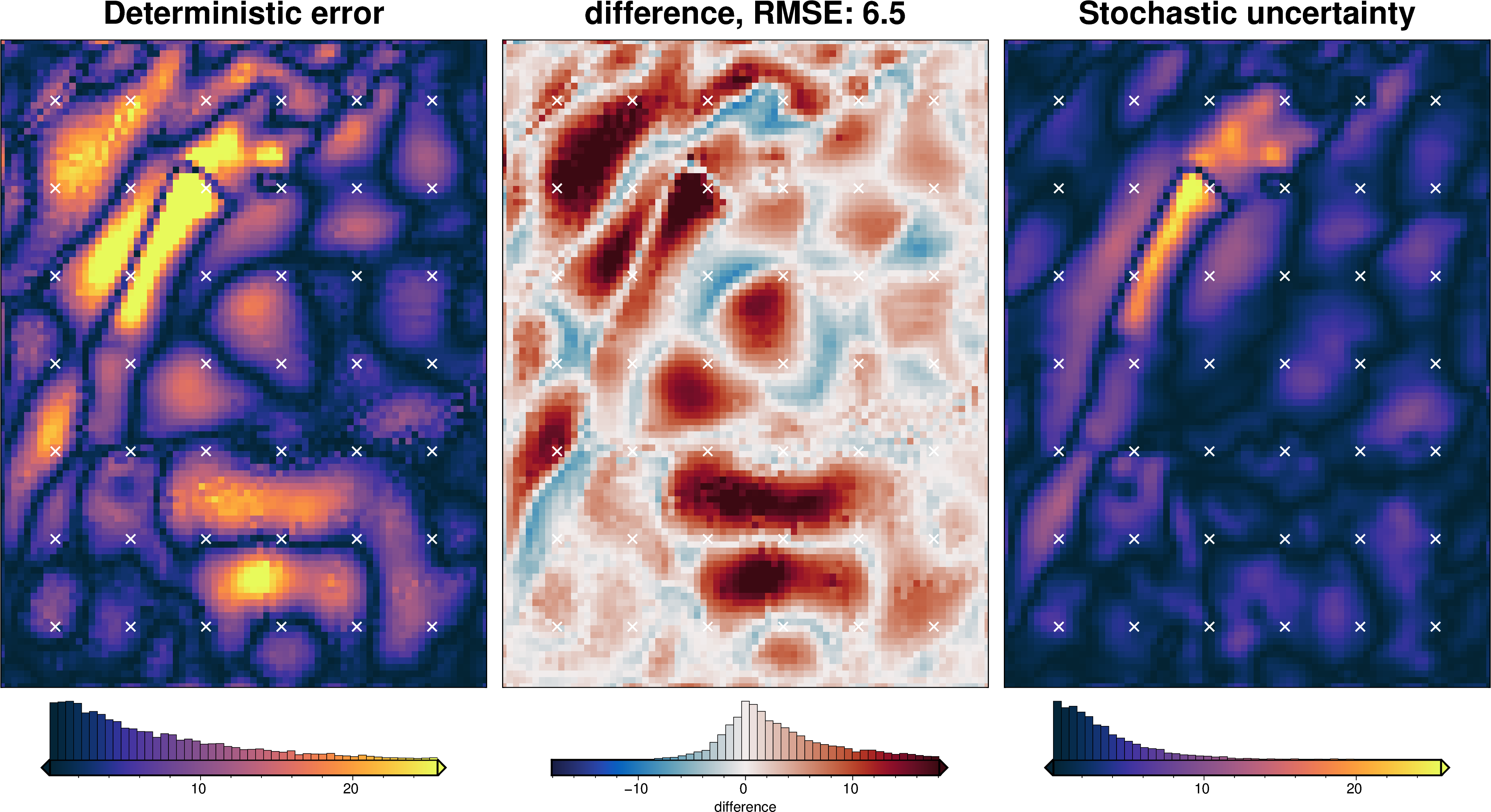
Total uncertainty
[56]:
fname = f"{fpath}_uncertainty_full"
# delete files if already exist
for p in pathlib.Path().glob(f"{fname}*"):
p.unlink(missing_ok=True)
uncert_results = uncertainty.full_workflow_uncertainty_loop(
fname=fname,
runs=20,
parameter_dict=solver_dict | density_dict,
**uncert_kwargs,
)
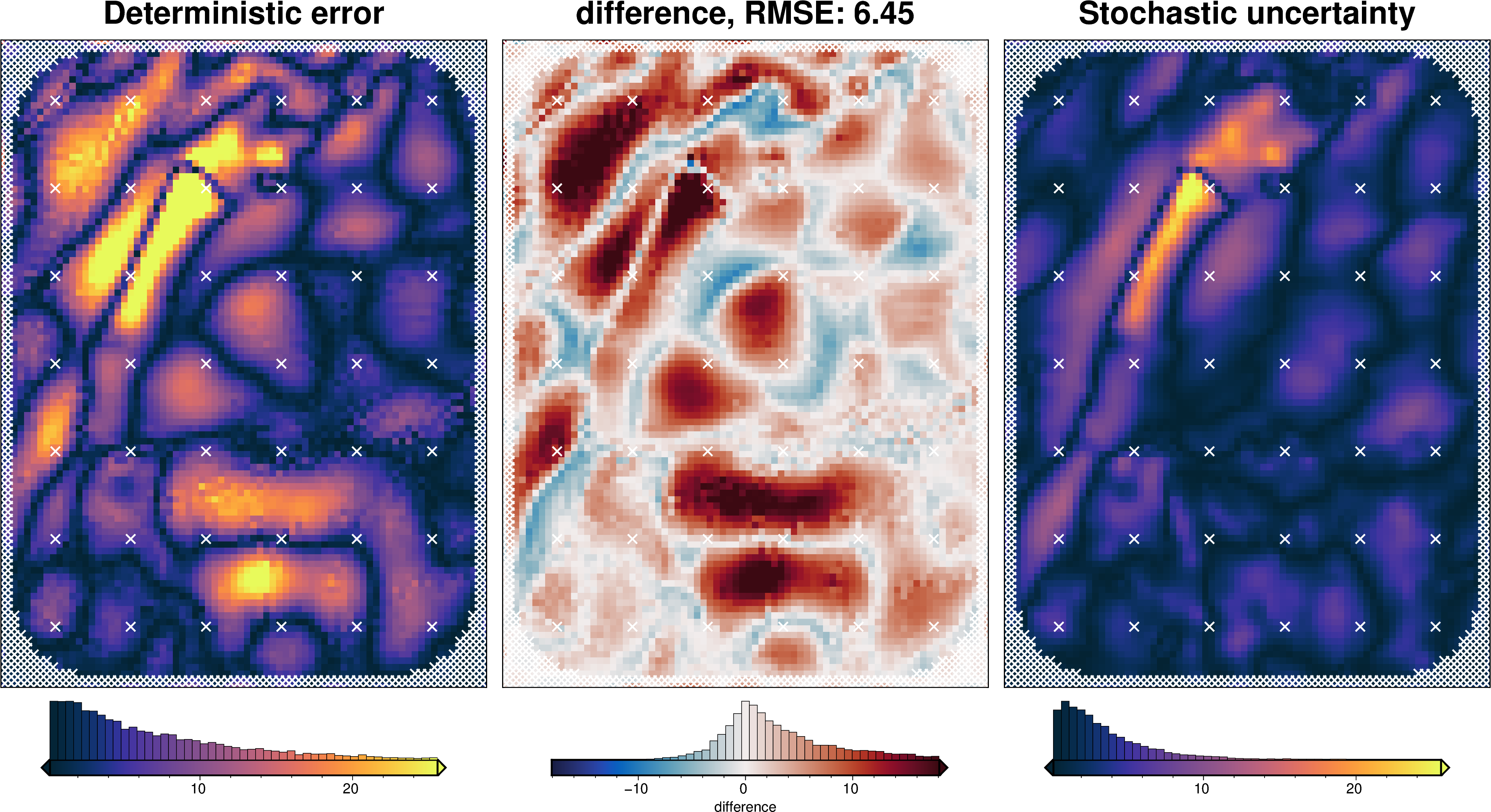
stats_ds = synth_plotting.uncert_plots(
uncert_results,
inversion_region,
bathymetry,
deterministic_bathymetry=final_topography,
constraint_points=constraint_points,
weight_by="constraints",
)
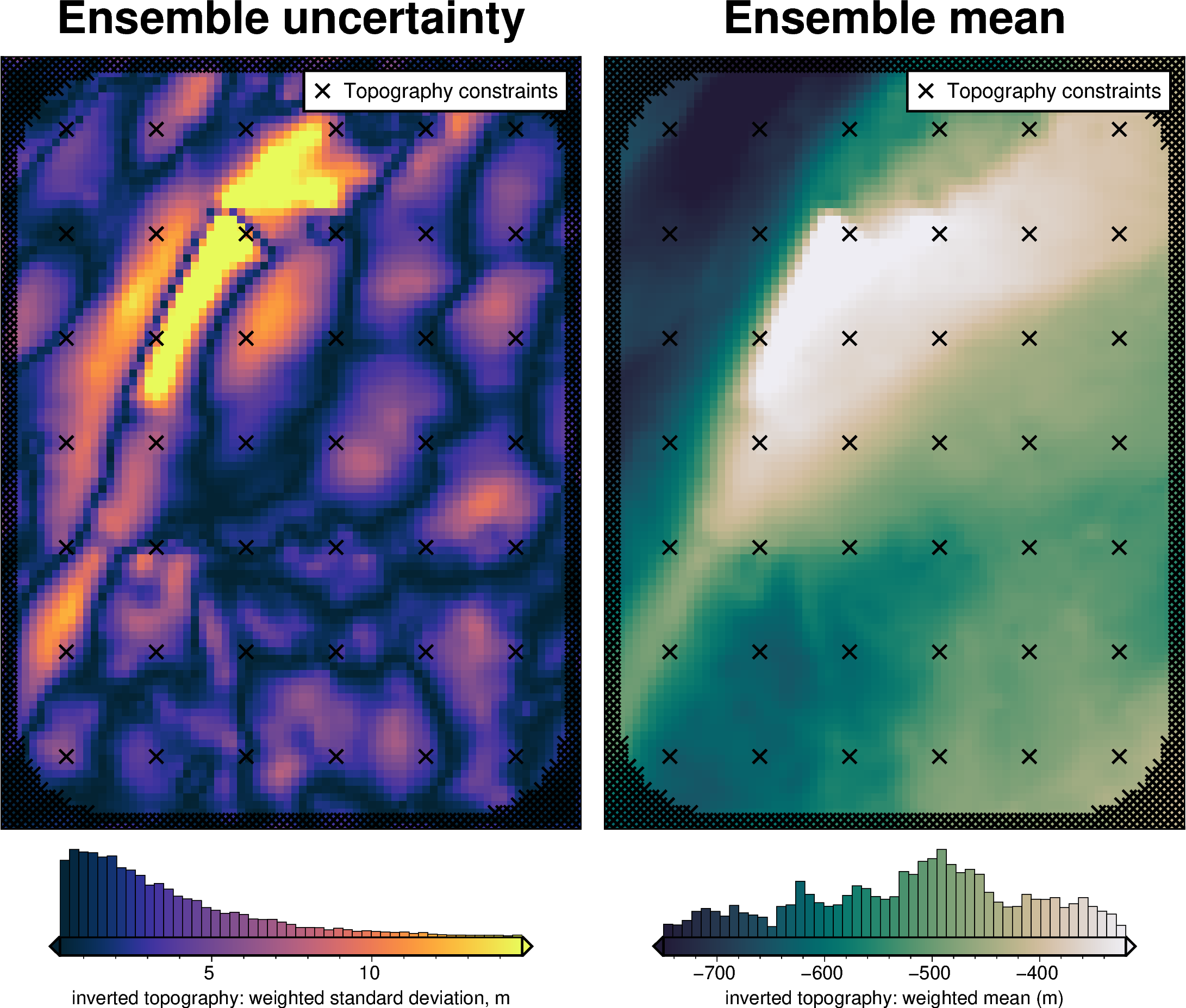
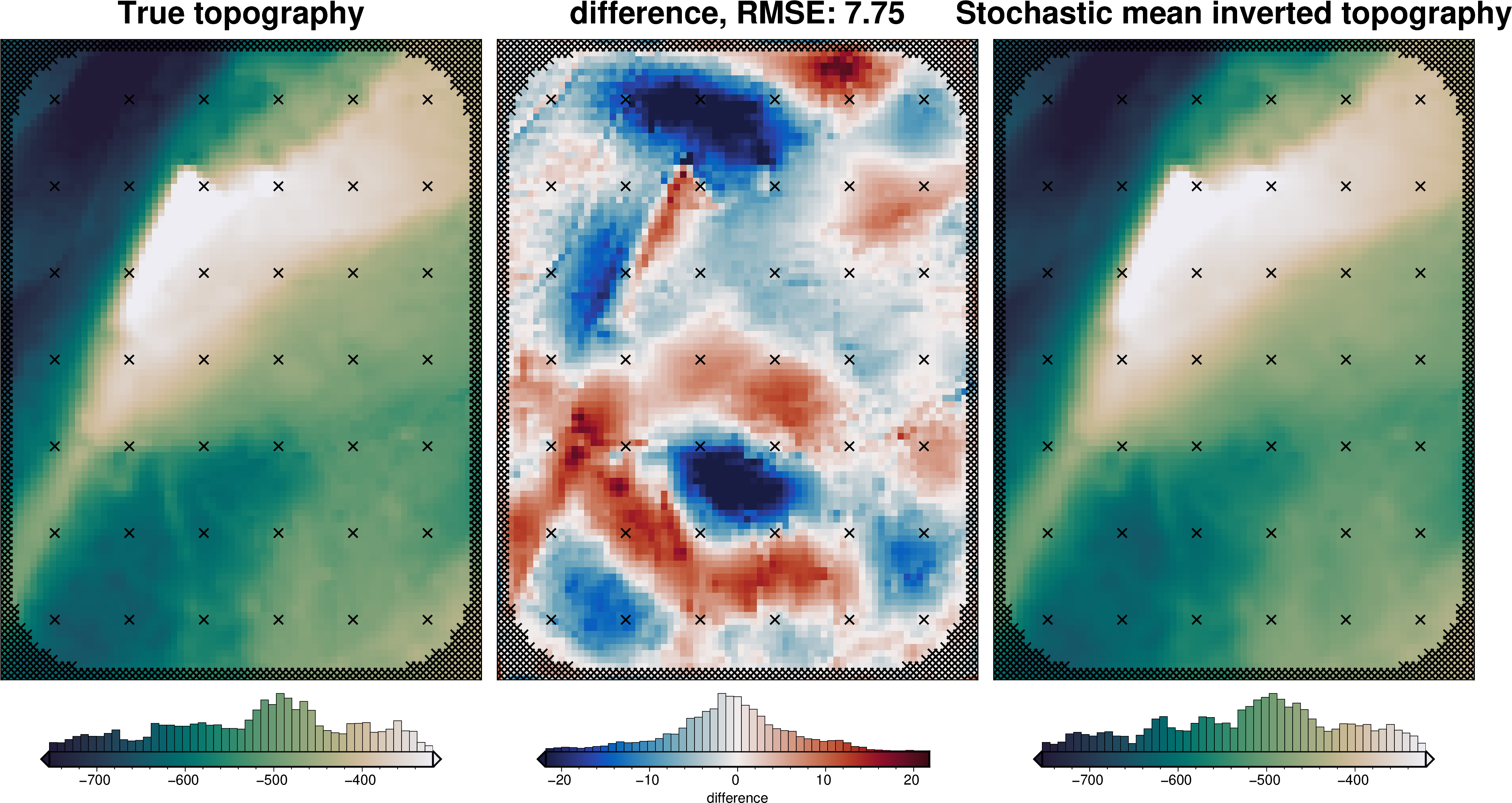
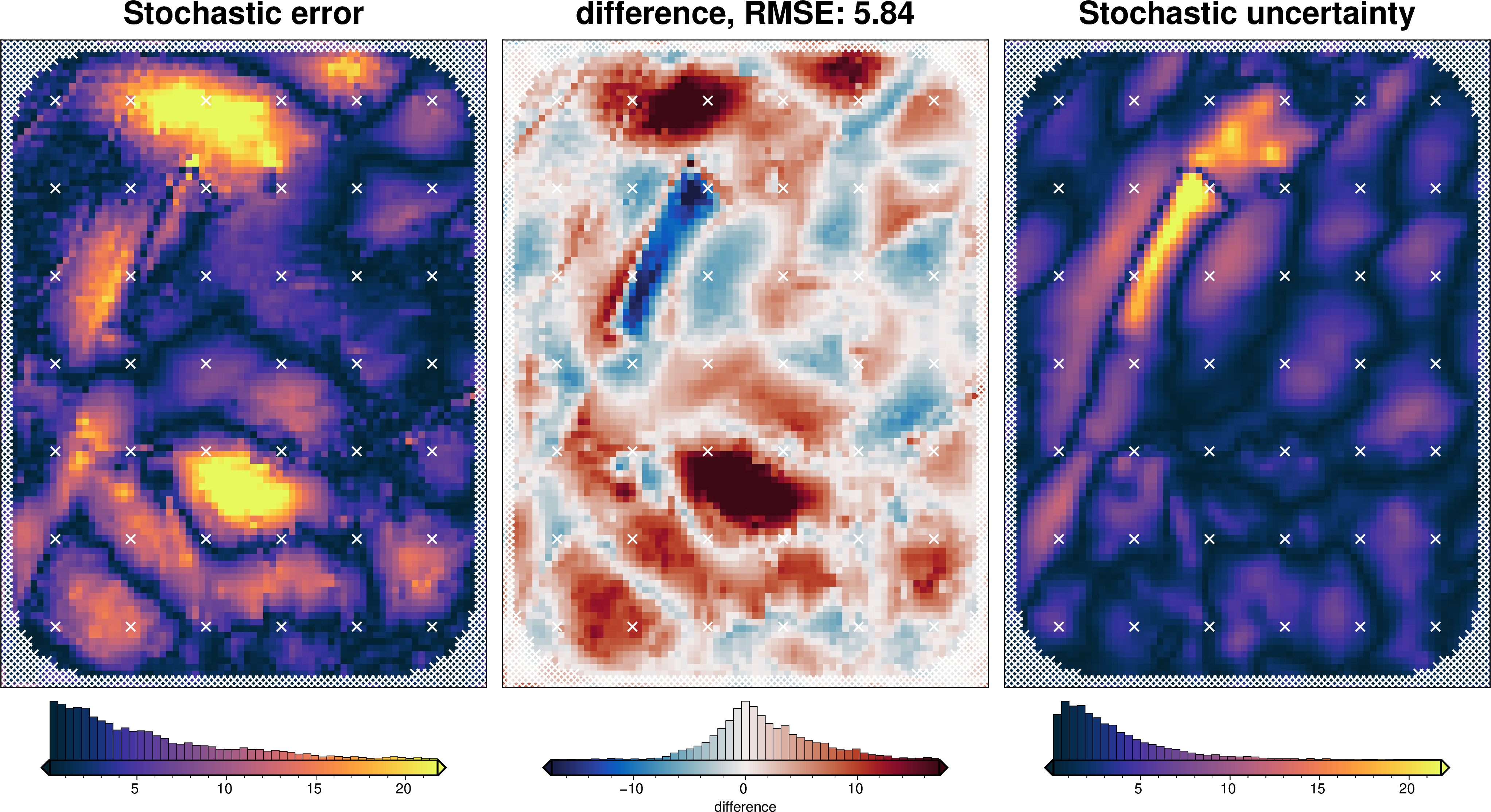
Comparing results
[57]:
results = [
uncert_results,
uncert_density_results,
uncert_damping_results,
]
# get cell-wise stats for each ensemble
stats = []
for r in results:
ds = uncertainty.merged_stats(
results=r,
plot=False,
constraints_df=constraint_points,
weight_by="constraints",
region=inversion_region,
)
stats.append(ds)
[58]:
names = [
"full",
"density",
"damping",
]
# get the standard deviation of the ensemble of ensembles
stdevs = []
for i, s in enumerate(stats):
stdevs.append(s.weighted_stdev.rename(f"{names[i]}_stdev"))
merged = xr.merge(stdevs)
merged
[58]:
<xarray.Dataset> Size: 186kB
Dimensions: (northing: 101, easting: 76)
Coordinates:
* northing (northing) float64 808B -1.6e+06 -1.598e+06 ... -1.4e+06
* easting (easting) float64 608B -4e+04 -3.8e+04 ... 1.08e+05 1.1e+05
Data variables:
full_stdev (northing, easting) float64 61kB 2.206 1.286 ... 1.54 1.362
density_stdev (northing, easting) float64 61kB 0.6075 0.5808 ... 0.8031
damping_stdev (northing, easting) float64 61kB 1.991 1.304 ... 0.9936[59]:
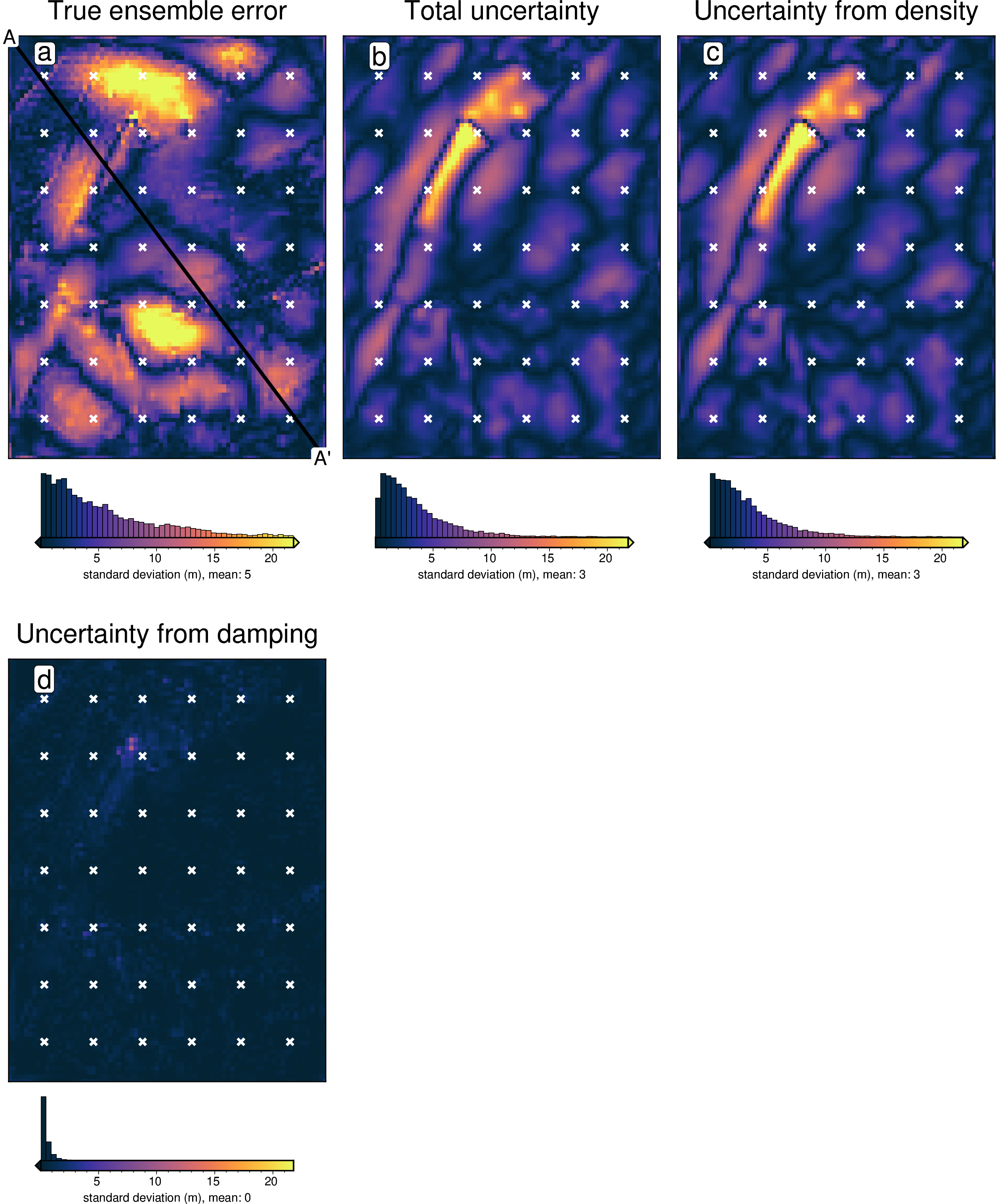
titles = [
"True ensemble error",
"Total uncertainty",
"Uncertainty from density",
"Uncertainty from damping",
]
grids = list(merged.data_vars.values())
grids.insert(0, np.abs(stats[0].weighted_mean - bathymetry))
cpt_lims = polar_utils.get_combined_min_max(grids, robust=True)
fig_height = 9
for i, g in enumerate(grids):
xshift_amount = 1
if i == 0:
fig = None
origin_shift = "initialize"
elif i == 3:
origin_shift = "both_shift"
xshift_amount = -2
else:
origin_shift = "xshift"
fig = maps.plot_grd(
grid=g,
fig_height=fig_height,
title=titles[i],
title_font="16p,Helvetica,black",
cmap="thermal",
cpt_lims=cpt_lims,
robust=True,
cbar_label=f"standard deviation (m), mean: {int(np.nanmean(g))}",
hist=True,
hist_bin_num=50,
fig=fig,
origin_shift=origin_shift,
xshift_amount=xshift_amount,
)
fig.plot(
x=constraint_points[constraint_points.inside].easting,
y=constraint_points[constraint_points.inside].northing,
style="x.2c",
fill="white",
pen="1.5p,white",
)
fig.text(
position="TL",
text=f"{string.ascii_lowercase[i]}",
fill="white",
pen=True,
font="16p,Helvetica,black",
offset="j.6/.2",
clearance="+tO",
no_clip=True,
)
if i == 0:
# plot profiles location, and endpoints on map
start = [inversion_region[0], inversion_region[3]]
stop = [inversion_region[1], inversion_region[2]]
fig.plot(
vd.line_coordinates(start, stop, size=100),
pen="2p,black",
)
fig.text(
x=start[0],
y=start[1],
text="A",
fill="white",
font="12p,Helvetica,black",
justify="CM",
clearance="+tO",
no_clip=True,
)
fig.text(
x=stop[0],
y=stop[1],
text="A' ",
fill="white",
font="12p,Helvetica,black",
justify="CM",
clearance="+tO",
no_clip=True,
)
fig.show()
[60]:
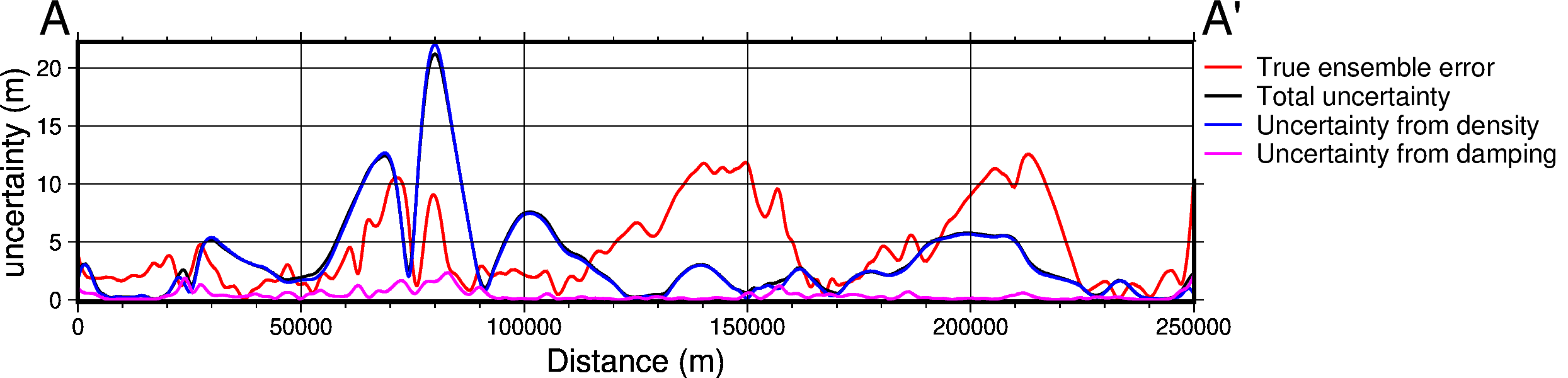
data_dict = profiles.make_data_dict(
names=titles,
grids=grids,
colors=[
"red",
"black",
"blue",
"magenta",
"cyan",
"green",
"purple",
],
)
fig, df_data = profiles.plot_data(
"points",
start=[inversion_region[0], inversion_region[3]],
stop=[inversion_region[1], inversion_region[2]],
num=10000,
fig_height=4,
fig_width=15,
data_dict=data_dict,
data_legend_loc="jTR+jTL",
data_legend_box="+gwhite",
data_buffer=0.01,
data_frame=["neSW", "xafg+lDistance (m)", "yag+luncertainty (m)"],
share_yaxis=True,
start_label="A",
end_label="A' ",
)
fig.show()
grdtrack [WARNING]: Some input points were outside the grid domain(s).
grdtrack [WARNING]: Some input points were outside the grid domain(s).
grdtrack [WARNING]: Some input points were outside the grid domain(s).
grdtrack [WARNING]: Some input points were outside the grid domain(s).
[61]:
# save results
merged.to_netcdf(f"{fpath}_sensitivity.nc")
[62]:
stats_ds.to_netcdf(f"{fpath}_uncertainty.nc")
[ ]: